
 English
 Русский
 Español
Why delivery speed has become an environmental issue
Why businesses increasingly demand faster delivery
Delivery speed has become not only a service advantage, but also a management habit. Sales, procurement and operations teams increasingly set short delivery windows by default: the customer expects it faster, the warehouse does not want to hold stock, production needs to cover a shortage “today for tomorrow”. At the level of a single shipment request, this looks rational. At the level of a logistics network, this urgency changes the economics of the route.
Why fast delivery does not always mean efficient logistics
Transport remains a major source of emissions: the International Energy Agency (IEA) states that in 2022, CO₂ emissions from transport increased by 3% after the recovery of passenger and freight activity. For businesses, the issue is not speed itself, but the price logistics pays for reducing lead time: less time for consolidation, poorer vehicle utilization, fewer route options, and more frequent reliance on more energy-intensive transport.
The main problem: urgency often disrupts route and load planning
When a shipment is arranged at the last moment, the carrier works not with a planned chain, but with constraints. Cargo moves separately, the route is built around the deadline, and transshipment and first-mile operations become less flexible. That is why fast delivery increases the carbon footprint not by itself, but through specific operational decisions: an urgent trip, partial load, refusal to consolidate shipments and additional movements.
What is the carbon footprint of delivery?
A simple definition of carbon footprint in logistics
The carbon footprint of delivery is the amount of greenhouse gases generated by cargo transportation and related operations. In logistics, it is usually measured not as “pure” CO₂, but as CO₂ equivalent: this converts different gases into a common unit of measurement based on their climate impact. In corporate reporting for freight transportation, indicators such as kg CO₂e per tonne-kilometre or per container-kilometre are often used; this approach is described in the GHG Protocol methodology for calculating emissions from transportation and distribution under Scope 3.
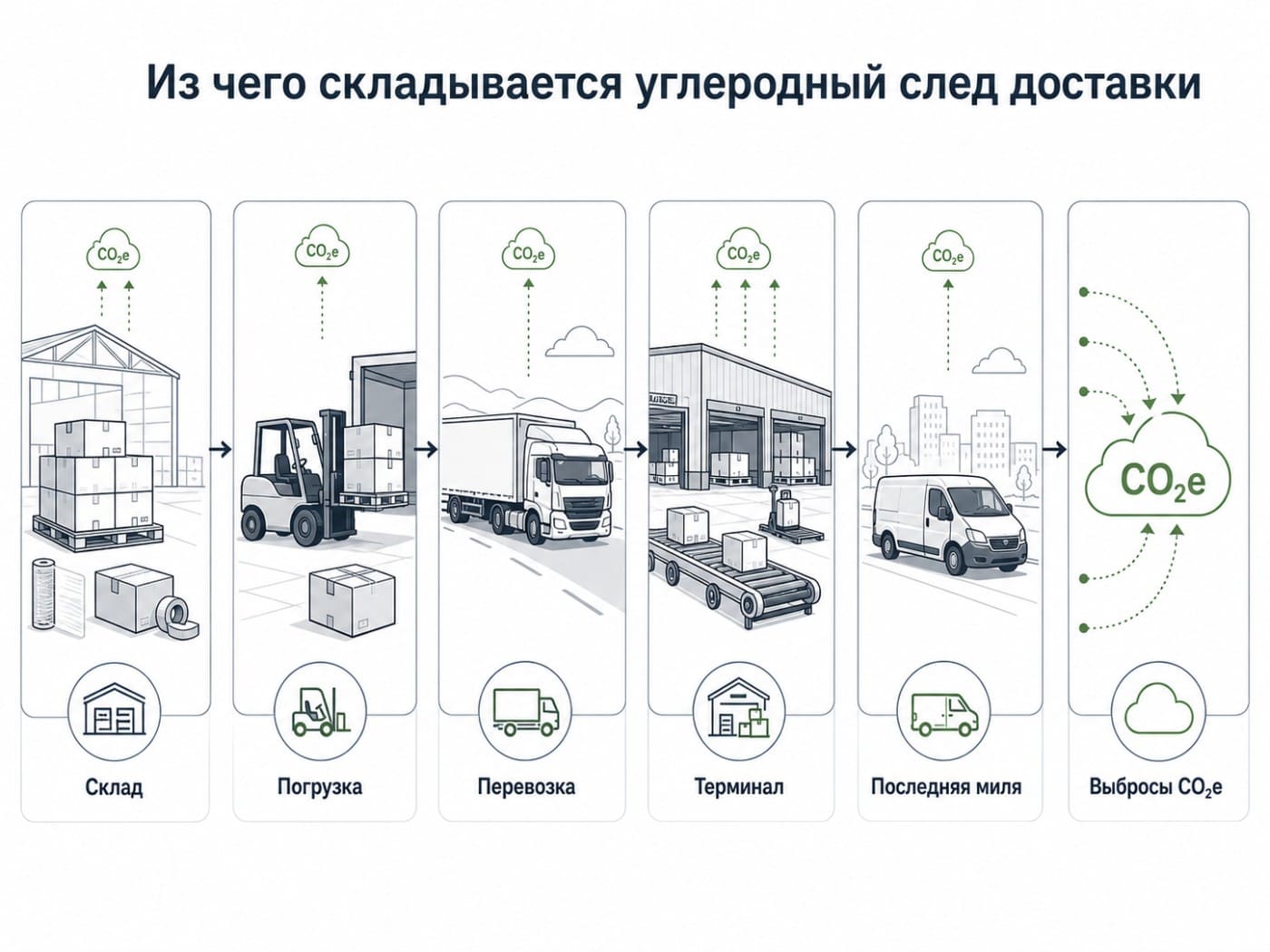
For businesses, this is not an abstract environmental indicator. It shows how rationally the shipment is organized: whether the right transport mode was selected, whether the vehicle is fully loaded, whether there is empty mileage, how many times the cargo was transshipped, and whether the route had to be urgently rebuilt.
Which emissions are included in freight transportation
The calculation may include direct emissions from transport, emissions from fuel or electricity production, as well as emissions from logistics nodes: warehouses, terminals, ports, airports and sorting facilities. The GLEC Framework describes emissions calculation for freight transportation and logistics hubs, taking into account both transport operations themselves and the energy used to perform them.
In practice, the calculation boundaries depend on the task. If a company is comparing two transportation options, it is enough to see emissions by route and transport mode. If supply chain reporting is being prepared, the scope has to be broader: first mile, mainhaul, terminal operations, last mile, storage and reverse logistics.
Why carbon footprint depends on more than distance
Two shipments over the same distance can have different carbon footprints. The reason lies in load factor, transport mode, route, number of transshipments, fuel type, road conditions and how the return trip is organized.
For example, a truck that runs almost empty allocates emissions across a smaller cargo weight. Per pallet or per tonne, such transportation will carry a heavier carbon footprint than a fully loaded trip. The same applies to the route: the direct path on a map is not always the same as an efficient logistics scheme. Sometimes a longer route with consolidation and a rail leg produces a lower impact than urgent road delivery of a separate shipment.
How emissions differ at the level of one shipment and the entire supply chain
At the level of one shipment, the business sees a specific operation: pick up the cargo, deliver it on time, cover the needs of the warehouse or customer. Here, the carbon footprint is calculated for a specific route, shipment lot, vehicle or request.
At the supply chain level, the picture is different. What matters is not only individual trips, but the repeatability of decisions: how often the company splits shipments, how many urgent requests arise because of weak planning, how consistently the supplier provides accurate cargo parameters, and whether shipments can be consolidated. One urgent delivery rarely changes the overall emissions profile. A system of urgent deliveries does.
How fast delivery increases the carbon footprint
Why urgent shipments are harder to consolidate with other cargo
Consolidation requires time: shipments must be collected, directions matched, cargo compatibility checked, and loading and unloading windows agreed. An urgent request sharply narrows this window. The carrier is no longer looking for the densest loading scheme, but is solving the deadline problem.
As a result, a small shipment is more likely to leave as a separate trip or take space in a less rational scheme. This is especially noticeable in road delivery and first-mile operations: if the cargo must be picked up today, the planned route of a courier, groupage vehicle or regional carrier is disrupted for the sake of one shipment.
How partial vehicle loading increases emissions per unit of cargo
Transport does not emit greenhouse gases in proportion to each box, but as part of the trip. The truck still drives, the aircraft still flies, the vessel still follows the route. The less cargo there is for that operation, the higher the emissions per unit of goods.
This is why logistics is not only about kilometres, but also about load factor. The GLEC Framework specifically states that empty mileage cannot simply be excluded from calculations: its impact must be allocated to the transport operation because it remains part of real logistics activity.
For the shipper, this means a simple thing: an urgent truck carrying a small shipment may look manageable in terms of timing, but per kilogram or pallet its environmental load will be higher than that of a planned shipment as part of a fuller load.
Why frequent small deliveries can be worse than planned batches
Frequent small deliveries create more operations: more pickups, more deliveries, more documents, more warehouse movements, and more last-mile trips. Each separate shipment may seem small, but in total it can produce a heavier scheme than one planned batch.
For B2B, this is especially critical for regular deliveries of components, packaging, consumables, spare parts, goods for networks of outlets or production sites. If procurement constantly covers shortages with small urgent batches, logistics turns into firefighting mode. The carbon footprint grows not because of one decision, but because of a repeated pattern of behaviour.
How urgency affects the choice of more expensive and energy-intensive transport modes
When the deadline is tight, the business loses some transport options. Sea freight, rail, groupage routes and multimodal schemes require planning. Express delivery more often pushes the choice toward air freight, direct road transport or a dedicated vehicle.
The difference between transport modes is significant. The IPCC Sixth Assessment Report states that in 2019, the largest source of transport emissions was road passenger and freight transport — 6.1 Gt CO₂e, or 69% of transport sector emissions; international shipping accounted for 0.8 Gt CO₂e, and international aviation for 0.6 Gt CO₂e. For an individual shipment, this does not mean an automatic ban on air or road transport. But urgency often filters out more energy-efficient options before they are even compared.
Why last-minute route changes almost always reduce efficiency
A late route change affects three things: loading, schedules and connections. A truck may depart without being fully loaded. A terminal receives cargo outside a convenient window. The carrier is forced to rearrange trips, find replacements, add an extra pickup or arrange interim storage.
As a result, logistics loses what efficiency is built on: predictability. The less time there is for preparation, the higher the likelihood of extra kilometres, empty movements and costly decisions chosen not because they are rational, but because there are no other options left.
Main factors that make delivery “dirtier”
Transport mode: air, road, rail and sea freight
The transport mode sets the baseline emissions level, but it must be evaluated with regard to the cargo, route and deadline. Air freight is suitable for expensive, urgent, perishable or critical cargo, but it usually generates high emissions per tonne-kilometre. Road transport is flexible and indispensable for the first and last mile, but is sensitive to load factor, mileage and return trips. Rail and sea are often more rational on long-distance legs, but require time, schedules and coordinated infrastructure.
Corporate emission factors by transport mode are published in specialized databases for environmental reporting. For example, the UK government annually updates conversion factors for calculating greenhouse gas emissions, including transport categories. In practice, however, what matters is not the reference figures themselves, but the basic logic: the comparison should not be between abstract formats such as “fast or slow”, but between complete transportation schemes.
Route length and number of transshipments
A long route is not always worse than a short one if it uses a more suitable transport mode and achieves high utilization. But extra transshipments almost always complicate the chain: cargo is moved between warehouses, terminals, trucks, containers or air waybills. Each such operation requires equipment, energy, personnel, time and control.
The problem with urgency is that it often adds intermediate actions without strategic benefit: temporary storage, a separate delivery to the terminal, cargo transfer between trips, emergency reissue of documents. Formally, the cargo is moving toward the consignee. In reality, the chain becomes heavier.
Empty mileage and return trips without cargo
Empty mileage is one of the main hidden sources of inefficiency. If a truck drives to pick up cargo without a load or returns empty after delivery, fuel is burned, but no useful transport work is created. For urgent transportation, the risk is higher: it is harder for the carrier to find return cargo, match directions and integrate the trip into the existing network.
For the shipper, empty mileage is often invisible. In the request, they see the price and delivery time, not how the truck reached the loading point or where it went after unloading. But in the real economics of transportation, these kilometres do not disappear: they are either already included in the rate or reflected in the carbon footprint of the chain.
Errors in cargo, address and timing data
Incorrect weight, inaccurate dimensions, an unspecified temperature regime, an incomplete address, no warehouse contact, or the wrong loading window all increase the risk of unnecessary operations. The truck arrives at the wrong location, waits, leaves for a repeat dispatch, the cargo does not fit, another type of transport is required, or additional packaging is needed.
In urgent delivery, the cost of an error is higher. There is almost no time to correct it, so the decision is made bluntly: send a dedicated truck, add forwarding support, rebook the trip, or move the cargo through another terminal. The environmental footprint grows together with operational chaos.
Packaging, warehouse operations and additional movements
Packaging also affects the carbon footprint, although it is often perceived separately from transportation. The worse the cargo is prepared for transport, the higher the risk of damage, repackaging, return or repeat shipment. In urgent delivery, packaging decisions are often made at the last minute: the available option is used, rather than the one best suited to the route, temperature, transshipments and transport mode.
Warehouse operations add another layer of impact. Forklifts, sorting lines, cold rooms, lighting, docks and internal movements are all part of physical logistics. If cargo is moved several times between facilities only because the route was assembled in a hurry, the carbon footprint grows even without increasing the mainhaul distance.
Why fast delivery often costs more for businesses
How urgency increases transportation costs
Urgent transportation is more expensive not only because of a higher rate. The price rises because the carrier has less time to find a load match, a return trip, a convenient loading window and a cheaper route. Instead of planned logistics, the task becomes “pick up and deliver at any cost within a short timeframe”.
In B2B, this quickly appears on the invoice: a dedicated truck instead of a groupage shipment, an air leg instead of sea or rail, an additional cargo pickup, overtime warehouse work, paid waiting time, and urgent document processing. If the cargo is not prepared for shipment in advance, costs start accumulating even before the mainhaul begins.
Why express logistics reduces the room for choice
The less time there is before dispatch, the fewer options are available. The carrier can no longer calmly compare several schemes: groupage transportation, a dedicated truck, a multimodal route, consolidation through a terminal, a rail or sea leg. Only the solutions that are physically available right now remain in play.
That is why express logistics often buys not speed as value, but time shortage as a problem. The business pays for the decision being made late: less competition between carriers, less route flexibility, and fewer chances to use transport with high utilization.
How poor planning leads to unnecessary costs
Poor planning is almost always disguised as urgency. Procurement approved the supplier late, the warehouse did not provide accurate dimensions, production failed to account for replenishment lead time, the sales department promised the customer a date without checking logistics — and the shipment becomes “emergency”.
The chain then starts becoming more expensive. The truck arrives in an inconvenient window. The cargo waits for packaging. Documents are redone. The route changes after calculation. The shipment leaves separately, although it could have been consolidated with other shipments. In the financial report, this looks like a high transportation cost, but the cause lies earlier — in inventory management, communication and the quality of source data.
Why environmental impact and financial losses often have the same cause
The carbon footprint and unnecessary costs grow from the same source: inefficient transport work. Empty mileage, partial loading, unnecessary transshipment, repeat vehicle dispatch, urgent route changes — all of these increase both emissions and cost at the same time.
The connection is direct. If cargo moves in a dedicated truck with low utilization, the business pays almost the full cost of the trip, while emissions are distributed over a smaller volume of goods. If the route is rebuilt at the last moment, additional kilometres and operations appear. If air freight is chosen instead of a planned sea or rail leg, the lead time is reduced, but the carbon load usually increases: the European Environment Agency states that rail and waterborne transport have the lowest emissions per kilometre and unit transported, while aviation and road transport create a significantly higher impact.
When fast delivery is actually justified
Perishable, valuable and critical cargo
Fast delivery is not always a mistake. Some cargo requires speed as part of preservation, safety or commercial value. Such categories include perishable products, pharmaceuticals, medical devices, urgent spare parts, production samples, expensive electronics and components for a stopped production line.
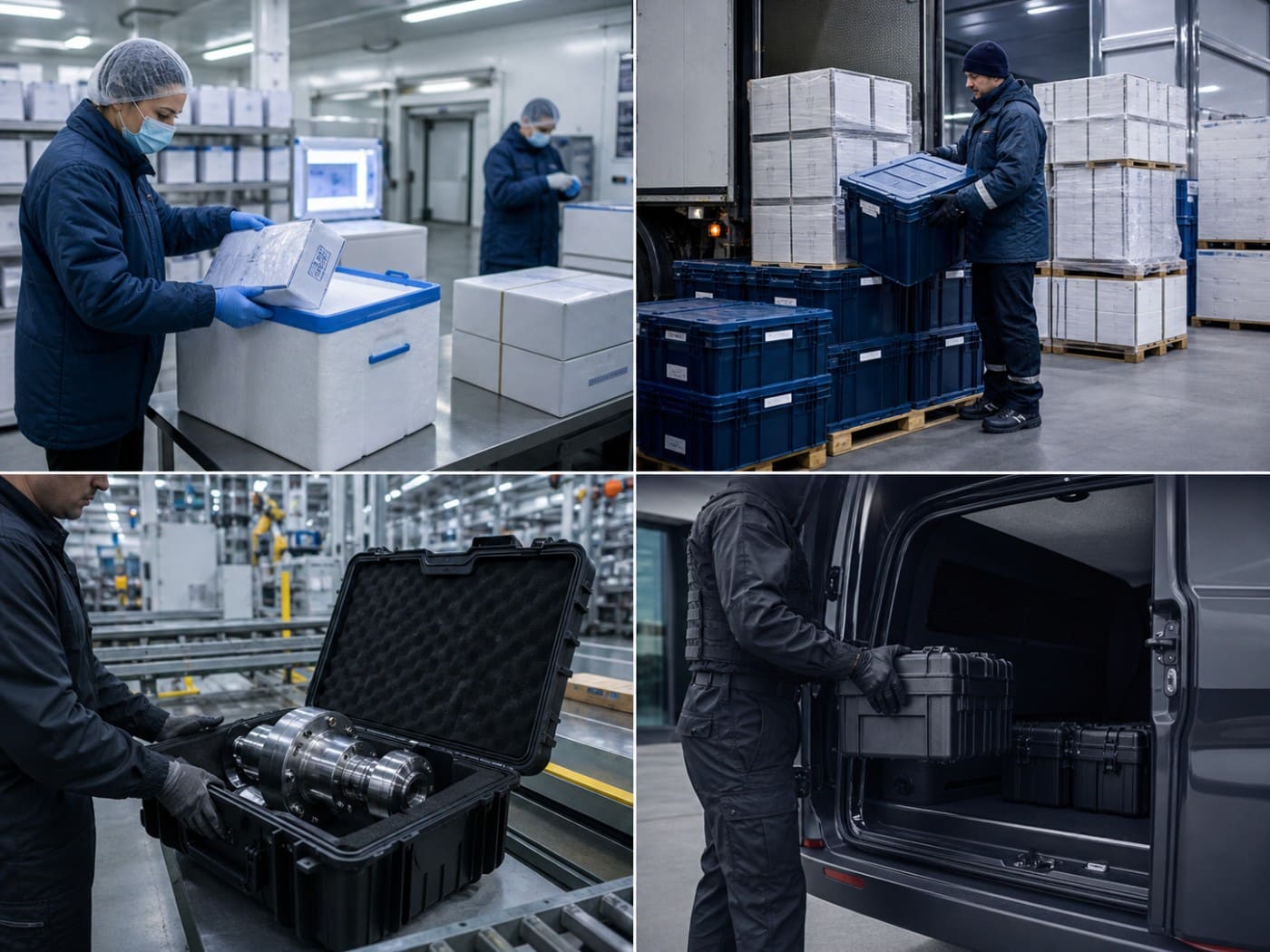
In such situations, saving time may prevent shipment write-off, process shutdown, penalties or customer loss. The task here is not to reject fast transportation at any cost, but to avoid using urgency where it can be replaced by proper planning.
Situations where delay costs more than urgent transportation
Urgent transportation is justified when the consequences of delay cost more than the premium for speed. For example, a production line cannot continue operating without a specific component. A retailer risks failing a contractual delivery. An importer has a limited receiving window for seasonal goods. A medical institution has a critical need for consumables.
In such scenarios, the environmental impact does not disappear, but the decision is assessed through a balance of risks. The business needs to record the reason for urgency, compare the options and choose the route that meets the deadline with the fewest unnecessary operations.
Why not every urgent delivery is a mistake
The mistake is not fast delivery itself, but the automatic choice of urgent mode without checking alternatives. If the cargo is genuinely critical, express logistics performs its function. If urgency arises from the habit of working without a time buffer, it becomes an expensive and carbon-intensive way to compensate for management failures.
The problem becomes worse when a company does not analyze repeatability. One urgent trip can be explained. Regular urgent trips on the same routes already point to a systemic defect: incorrect inventory levels, weak demand forecasting, poor coordination between procurement and logistics, and late placement of orders with suppliers.
How to distinguish real urgency from a management habit
Real urgency responds to a specific risk: what exactly will happen if the cargo arrives later. A management habit is worded differently: “it is more convenient for us this way”, “the customer always asks for it quickly”, “we did not manage to approve it earlier”, “the warehouse will provide the information tomorrow, but it needs to be shipped today”.
The check is simple. Four questions need to be asked: is there economic damage from the delay, can the cargo be consolidated with the nearest planned shipment, does product quality change with a longer lead time, and who inside the company created the time constraint. If there is no precise answer, urgency should be treated not as a logistics requirement, but as a symptom of a poor process.
Alternatives that help reduce the carbon footprint
Cargo consolidation and planned shipments
Consolidation reduces the impact not through attractive environmental wording, but through the physics of transportation: one fuller trip replaces several fragmented shipments. For the shipper, this means fewer vehicle dispatches, fewer partial loads, and fewer first- and last-mile operations.
Planned shipments give the carrier time to combine compatible lots, choose a route, find a return load, and agree on the terminal and delivery window. In regular B2B logistics, this is often more important than a one-time saving on the rate. If a company knows its procurement or delivery schedule in advance, urgent mode should be an exception, not the operating standard.
Route optimization instead of choosing the fastest option
The fastest route is not always the most rational one. Direct road transport can meet the deadline, but result in low utilization and a high rate. A route through a consolidation terminal may take longer, but provide denser loading. A multimodal scheme may add a transshipment, but reduce the carbon load on the long-distance leg.
Optimization starts not with the question “how can it be faster”, but with a set of criteria: acceptable lead time, cargo weight and volume, shipment value, temperature requirements, risk of damage, transport availability, route stability and consignee requirements. If a business compares only the deadline, it rejects some of the more rational solutions in advance.
Multimodal transportation and combined schemes
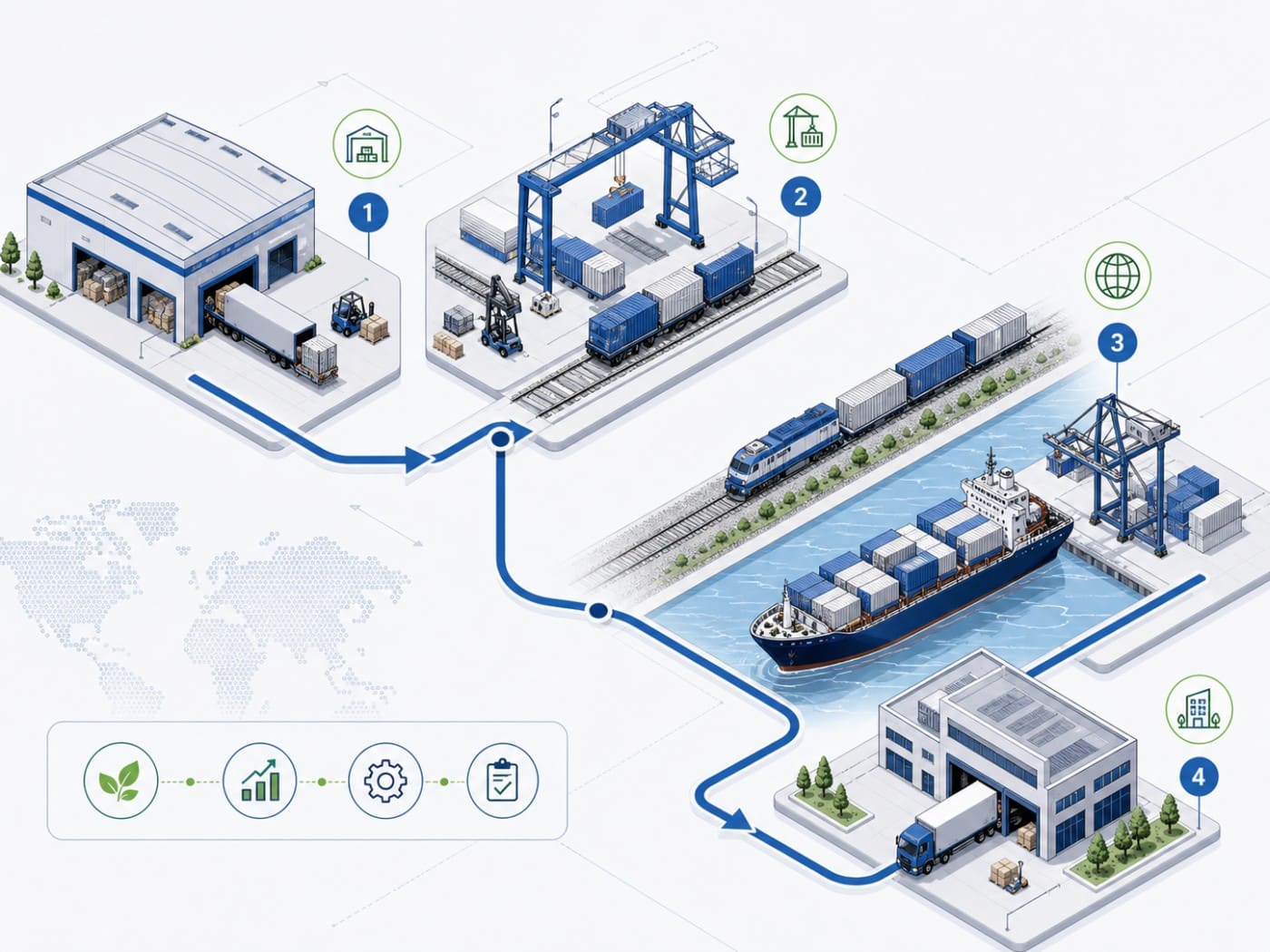
Multimodal transportation combines several modes of transport in one chain: for example, road transport to a terminal, rail on the long-distance leg, and road delivery to the consignee. Such a scheme is not always faster, but it often gives more control over cost and utilization over long distances.
The point is not to mechanically replace road transport with rail or sea. The point is to choose the right transport mode for each section of the route. Road transport is strong in flexibility, rail and waterborne transport are strong in high-volume and long-distance movements, and air freight is strong for critical deadlines. Sustainability appears where each transport mode is used for its intended purpose, rather than because of an emergency.
Choosing the right transport for the cargo type and deadline
For heavy and non-urgent cargo, it is more logical to look for a scheme with high utilization and a predictable schedule. For light, expensive and critical cargo, fast transportation may be justified. For regular batches, it is worth comparing not a one-off rate, but the repeatable model: how often the cargo is shipped, how stable the volume is, whether windows can be fixed, and whether there are seasonal peaks.
The IEA separately identifies aviation as a sector where emissions recovered quickly after the pandemic decline: in 2023, aviation accounted for 2.5% of global energy-related CO₂ emissions, and its emissions reached almost 950 million tonnes of CO₂. This does not make air freight unacceptable, but it does require discipline: use it where the deadline is genuinely critical, not where procurement or the warehouse submitted the request late.
More accurate first- and last-mile planning
The first and last mile often undermine the economics of the entire shipment. The mainhaul route may be well organized, but a failed pickup, repeat vehicle dispatch, waiting time at the warehouse or an inaccurate consignee address adds extra kilometres and costs.
Reducing the carbon footprint starts with basic operational discipline: accurate weight and volume before calculation, a correct address, a responsible warehouse contact, a realistic loading window, prepared documents, an understanding of access restrictions, and a transport type agreed in advance. This does not look like a loud environmental initiative, but it directly reduces the chaos that makes transportation more expensive and more emissions-intensive.
Practical scenarios: how the same cargo can be delivered in different ways
Scenario 1: urgent shipment of a small batch
A company purchases a small batch of components and realizes that without it, a production area will stop in two days. The cargo is not yet ready for dispatch, exact dimensions are still being clarified, and the consignee’s receiving window is strict. Logistics is given the task not of selecting a rational scheme, but of making the deadline.
In this scenario, a direct truck, express road transport or an air leg is more often chosen. Consolidation is almost unavailable: there is no time to wait for compatible cargo, agree on a terminal or find a return load. The cost rises because of urgency, and the carbon footprint rises because of low utilization, a short planning horizon and limited transport choice.
This is not necessarily a mistake if production downtime really costs more than urgent transportation. The mistake begins when this model repeats every week and is presented as a normal working process.
Scenario 2: planned shipment with consolidation
The same batch is known in advance: procurement has agreed the delivery time, the warehouse has provided weight and volume, and the consignee has confirmed the unloading window. The logistics specialist has several days to compare options and avoid shipping the cargo separately.
In this case, the batch can be consolidated with other cargo moving in a similar direction, shipped as groupage cargo, or included in a regular route. The lead time will be longer than with express delivery, but the transport work will be distributed over a larger cargo volume. The business receives not only a lower cost, but also a lower carbon load per unit of goods.
The main limitation is internal discipline. Consolidation works only when requests do not arrive at the last moment and cargo parameters are known before the transportation calculation.
Scenario 3: multimodal transportation with a longer but more rational route
If the cargo is moving over a long distance and does not require “today for tomorrow” delivery, a combined scheme can be built: road transport to the terminal, a rail or sea leg, and then road delivery to the consignee. On the map, such a route may look longer and more complex than a direct truck. In logistics, it is often more rational.
The advantage of a multimodal scheme is the ability to use each transport mode where it is stronger. Road transport covers flexible sections, rail or sea handles the long-distance leg, and the terminal allows shipments to be consolidated. The potential downside is more connections and higher requirements for planning, packaging, documents and lead-time control.
This option is not suitable for every shipment. But if the cargo is not time-critical and the route is repeated, a multimodal scheme may be better than direct urgent transportation in terms of cost, utilization and carbon footprint.
What to compare: time, cost, risks and environmental impact
Comparing transportation options cannot be reduced to two columns: “fast” and “cheap”. For B2B logistics, it is more important to see the full picture: what lead time is actually acceptable, how much a delay will cost, how full the load will be, how many transshipments there will be, whether there is a risk of damage, and whether the shipment can be consolidated with other cargo.
A practical approach is to compare not a separate rate, but the transportation scheme. One option may be cheaper on the invoice, but create more warehouse risks. Another may take two days longer, but be more stable in terms of route and better in terms of utilization. A third may be more expensive, but justified if a delay would stop production or lead to product write-off.
Comparison table: fast and planned delivery
| Criterion | Fast delivery | Planned delivery |
| Delivery speed | Minimum lead time, often with a strict deadline | Longer lead time, but it can be agreed in advance |
| Transportation cost | Usually higher due to urgency, limited choice and separate operations | Often lower through route selection, consolidation and better utilization |
| Consolidation opportunity | Limited: little time to combine shipments | Higher: compatible cargo and directions can be matched |
| Vehicle utilization | Often partial, especially for small batches | Higher if shipments are planned in groups |
| Route flexibility | Low: only available options remain | Higher: direct, groupage and multimodal routes can be compared |
| Number of unnecessary operations | Higher risk: urgent pickup, reissued documents, waiting time, repeat vehicle dispatch | Lower with accurate cargo parameters and agreed windows |
| Potential carbon footprint | Often higher per unit of cargo due to partial loading and energy-intensive decisions | Usually lower with consolidation, a stable route and fewer emergency actions |
| When it fits | Critical cargo, production disruption, perishable goods, high damage from delay | Regular deliveries, planned procurement, warehouse replenishment, cargo without strict urgency |