 English
 Русский
 Español
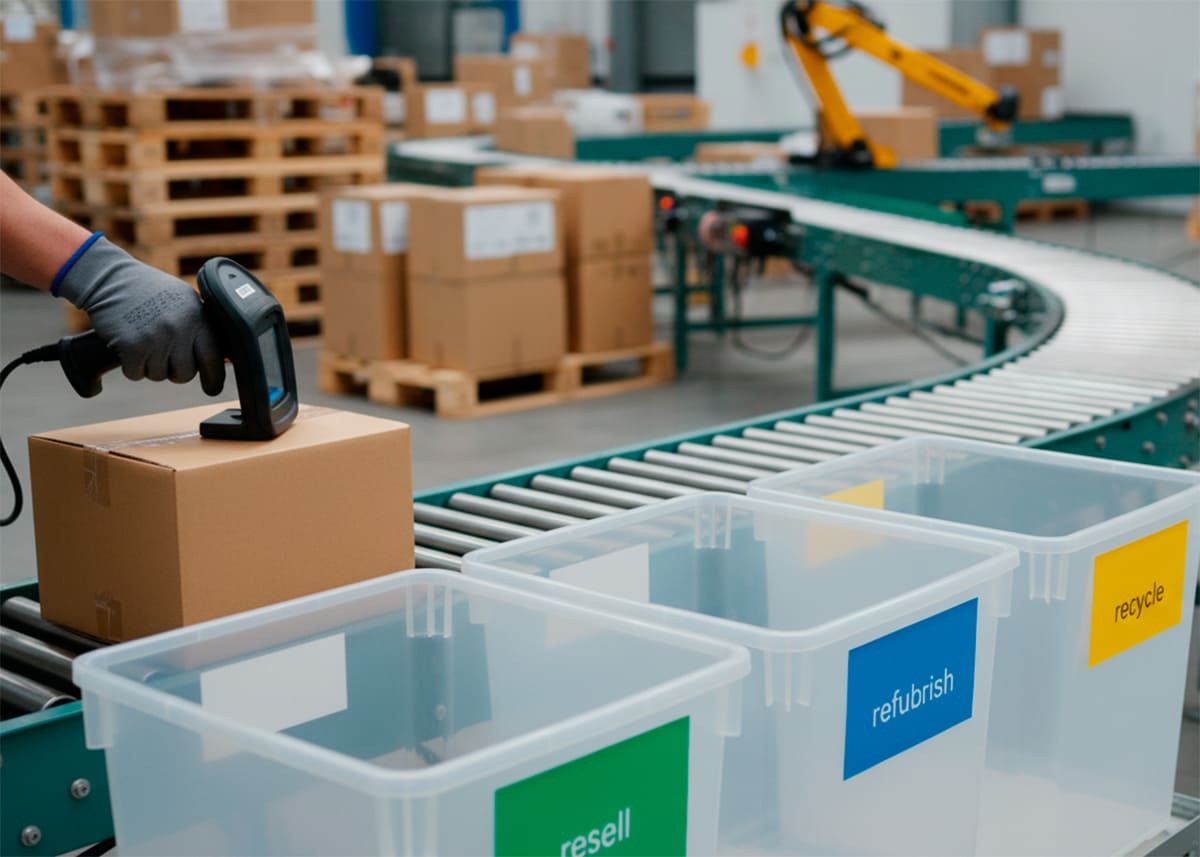
Reverse logistics is the process of moving goods from the customer back to the seller, manufacturer, warehouse, service center, or recycling facility. It helps companies recover value, reduce waste, control costs, and manage supply chains more efficiently.
What Reverse Logistics Means
Definition of Reverse Logistics
Reverse logistics is the organized management of goods, packaging, and materials moving from the point of consumption back to locations where they can be received, inspected, sorted, repaired, resold, recycled, or disposed of. The goal is to preserve as much economic value as possible while reducing waste.
Treating reverse flows as part of the overall supply chain matters for two main reasons. First, returns affect inventory levels, procurement planning, and warehouse capacity. If they are not accounted for properly, companies can end up carrying excess inventory and paying for unnecessary transportation and storage. Second, returns data can reveal recurring product defects, packaging problems, fulfillment errors, and service issues that might otherwise go unnoticed.
Returns Logistics and Reverse Logistics
Returns logistics and reverse logistics are closely related. Both involve moving goods, packaging, or materials from the customer or point of consumption back into the supply chain. Reverse logistics, however, generally covers a broader range of activities than simply returning a product to the seller. It can also include inspection, repair, refurbishment, resale, recycling, and disposal.
The distinction varies by company. Some businesses use "returns logistics" mainly for customer returns, while "reverse logistics" refers to the wider network of reverse flows, including reusable packaging, product recalls, equipment refurbishment, and end-of-life product management.
This distinction can be useful when designing processes and setting KPIs. A company that tracks only the transportation of returned goods back to a warehouse may understand the freight cost but overlook the cost of inspection, storage, repair, and returning the product to inventory. Managing these activities as one system provides better visibility into total costs and recoverable value, although it also requires more sophisticated routing rules, status tracking, and coordination among warehouse, service, finance, and external partners.
How Reverse Logistics Differs from Forward Logistics
Forward logistics moves goods from the manufacturer toward the customer and is generally designed around predictable volumes, routes, and delivery times. Reverse logistics involves greater uncertainty because returned items may differ in condition, timing, and reason for return. As a result, the next step often has to be determined item by item: return it to inventory, repair it, use it for spare parts, recycle it, or dispose of it.
Reverse logistics also affects the customer experience after the sale. Clear return policies and prompt refunds make the process easier for customers and can support repeat purchases. For operations teams, efficient handling of returns helps reduce the cost of inspection, storage, and write-offs, all of which can have a direct impact on margins.
Key Reverse Logistics Processes and Participants
Reverse logistics can involve manufacturers and service centers, distributors, 3PL providers, retailers, marketplaces, recyclers, waste-management companies, and the end customer who initiates the return. Typical processes include receiving and consolidating returns, inspecting and sorting products, repairing or refurbishing items, reselling them through primary or secondary channels, recycling materials, and disposing of products that cannot be recovered.
Main Types of Reverse Logistics
Reverse logistics can be classified according to what triggered the return and what happens to the product afterward. Common categories include customer returns, repair and refurbishment, returnable packaging, unsold goods, product recalls, and end-of-life product management.
| Type of Reverse Logistics | What Happens | Primary Business Objective |
|---|---|---|
| Customer returns | The product is returned by the customer to the seller, manufacturer, or warehouse | Assess its condition quickly and return eligible products to inventory |
| Repair and refurbishment | The product is inspected, repaired, or refurbished | Preserve the value of the product or its components |
| Returnable packaging | Pallets, containers, or reusable packaging are returned to the owner | Enable reuse without excessive transportation costs |
| Unsold goods | Excess inventory is returned to the supplier, redistributed, or moved to another sales channel | Reduce write-offs and storage costs |
| Product recalls | Products are removed from circulation following a manufacturer's decision or safety requirements | Maintain traceability and collect affected batches in a controlled manner |
| End of life | The product is dismantled for components, recycled, or disposed of | Recover residual value and comply with waste-management requirements |
This classification covers a much wider range of situations than standard customer returns. A reverse flow can also begin when leased equipment is returned, a product enters a service program, a recall is issued, or an item reaches the end of its useful life.
The most appropriate option depends largely on the product's residual value and the cost of processing it. For a low-value item, transportation, inspection, and restocking may cost more than the value that could be recovered. For equipment, electronics, high-value components, or reusable packaging, repair and reuse are often economically worthwhile.
How Reverse Logistics Works
Main Stages
The process usually begins when the returned item is received and identified by order, batch, or serial number, and the reason for the return is recorded. The item is then inspected and classified according to its condition: suitable for resale, in need of repair, usable for spare parts, recyclable, or ready for disposal. Once a decision has been made, it can return to inventory, move to a service facility, or be sent for dismantling and recycling.
The efficiency of the process depends heavily on how quickly and accurately these decisions are made. Clear inspection criteria, dedicated warehouse areas for returns, predefined routing rules, and regular feedback to procurement and quality teams can shorten processing times and reduce storage costs.
Returns Management and Reverse Logistics
Returns management is primarily concerned with receiving and processing a specific customer return. Reverse logistics covers what happens to the physical product afterward. A refund may complete the customer-facing part of the return, but the item itself may still need to be inspected, repaired, resold, recycled, or disposed of.
Once received, the product must be identified, inspected, sorted, and routed to the appropriate destination. These physical movements and the data associated with them are what turn an individual customer return into part of a broader reverse logistics process.
In B2C, speed and convenience are often the most visible measures of a successful return process. B2B returns usually involve additional considerations such as reverse freight costs, inspection costs, the residual value of equipment or a shipment, spare-parts availability, and the potential for reuse. Companies therefore need to balance speed with inspection accuracy. Fast processing improves service and reduces warehouse dwell time, but an overly simplified inspection process can result in an item being written off unnecessarily or returned to inventory when it still needs repair.
The Role of Digitalization and Automation
Digital systems make reverse flows easier to track and manage. ERP and WMS platforms can record item movements, reserve warehouse locations, and launch predefined workflows. RFID and IoT devices can speed up receiving and reduce identification errors. Automated sorting and rules-based routing allow the system to determine the next step based on product attributes, condition, and reason for return, reducing the number of manual decisions.
In e-commerce, returns can also be pre-authorized through a customer account, with a shipping label generated before the item is sent back. The warehouse then knows in advance which product is being returned and why. This makes it easier to plan receiving capacity and allocate labor.
Reverse Logistics in a Sustainable Supply Chain
Reverse logistics can be integrated with forward operations through shared inventory data, transportation planning, and warehouse processes. Returns may be collected on backhaul routes, while repaired or refurbished products can be returned to available inventory after inspection. Common KPIs include the time from return initiation to final disposition, the percentage of items returned to sale, processing cost per unit, the share of materials recycled, the amount of waste avoided, and compliance with environmental requirements.
The Business Value of Reverse Logistics
Economic Benefits for Businesses
A well-designed reverse logistics process can reduce overall costs because returned products do not automatically become a write-off. The faster an item is inspected, the sooner it can be returned to inventory, sold through another channel, repaired, or dismantled for usable parts. This reduces storage costs and limits the amount of inventory that ultimately has to be discarded.
Returns also generate useful operational data. Recurring defects, seasonal patterns, geographic concentrations, and high return rates for specific SKUs can point to problems with product quality, packaging, descriptions, or fulfillment. Companies can use this information to improve assortment decisions, reduce avoidable returns, increase inventory turnover, and make better use of warehouse space.
Environmental Effects and ESG Metrics
Effective reverse logistics can reduce waste by extending the useful life of products and materials through repair, reuse, and recycling. Recovering usable components, recycling transport and consumer packaging, and reselling suitable products can reduce the need for replacement production and the resources associated with it.
Reverse logistics can also provide measurable data for ESG reporting. Relevant indicators may include the share of products refurbished, recycling rates, the volume of materials recovered, and the amount of waste avoided. These practices support circular economy principles by keeping products and materials in use for longer.
When Reverse Logistics Pays Off
Building a reverse logistics system requires investment in tracking systems, warehouse space, inspection procedures, routing rules, and relationships with repair and recycling partners. The financial case usually becomes stronger as return volumes grow and the process becomes more predictable.
The system performs best when products move quickly from inspection to a clear decision and then to the appropriate next step. Companies can measure the financial impact through lower write-off, storage, and disposal costs, a higher resale rate, and shorter processing times. SLA targets can also be used to control performance, for example by setting a maximum return processing time or a target percentage of cases completed within the agreed period.
Reverse Logistics in E-commerce and Manufacturing
Online Retail
In e-commerce, returns are a routine part of customer service. A streamlined return process typically includes online authorization, a ready-to-use shipping label, clear timelines, and prompt refunds once the return has been received or verified.
At the warehouse, the item can be routed directly to the appropriate area based on its SKU and known return reason. Products in good condition may go through a quick inspection and return to inventory, while questionable items are sent for more detailed testing, repair, or recycling. Automating receiving, routing, and inventory updates reduces manual work and makes the return process easier for the customer.
Manufacturing Companies
In manufacturing, reverse logistics is closely tied to repairability and product design. Returning components for inspection, refurbishment, or parts recovery can help extend equipment life and reduce after-sales service costs.
In electronics, returned circuit boards and assemblies may undergo functional testing before they are repaired or reused. Automotive components can be remanufactured and returned to service, while in household appliances, housings and packaging may be recycled and working components reused for repairs. The financial benefit can come from purchasing fewer new parts, reducing equipment downtime, and managing spare-parts inventory more efficiently.
Relationship with After-Sales Logistics
After-sales logistics covers the movement of products and spare parts, as well as service activities after a sale. Reverse logistics focuses on products moving back from the customer into the supply chain. The two processes overlap in warranty returns, repairs, equipment replacement, and component refurbishment, but they are not the same.
For example, shipping a replacement part to a customer is part of after-sales logistics and follows the forward flow. Sending the defective component back to a service center is part of reverse logistics. After repair, the same component may re-enter the forward supply chain.
For equipment manufacturers and other B2B companies, integrating these processes provides visibility into the full life cycle of an asset, from delivery and operation to return, inspection, repair, and reuse. The trade-off is greater data complexity. Each physical unit may need to retain information about its serial number, warranty status, failure reason, repair cost, and movements between the customer, warehouse, and service center. Without consistent data, the financial impact of reverse logistics is difficult to measure accurately.
How the Same Principles Apply in Other Industries
Similar principles are used in aviation, operating leases, and FMCG. In aviation, high-value repairable components are returned for inspection and refurbishment while their remaining service life is carefully tracked. Under equipment leasing models, assets returned at the end of a lease are inspected, repaired when necessary, and either reassigned or resold. In FMCG, returnable packaging, inventory transfers between warehouses, and packaging recycling create smaller reverse flows within the supply chain.
In each case, the financial outcome depends on how quickly the company can assess the condition of an asset and select the most appropriate option, whether reuse, repair, resale, recycling, or disposal.
Reverse Logistics in International Supply Chains
In international trade, reverse logistics involves more than transporting goods back to their point of origin. Companies may also have to manage cross-border movements, transport documentation, customs procedures, and decisions about where inspection, repair, resale, or recycling should take place. This makes international reverse logistics more complex than handling a return within a single country.
Returning the product to the original supplier is not always the most economical option. A company may choose to inspect or repair the product locally, resell it in the local market, recycle it, or consolidate several returns into one international shipment. The best reverse route may therefore be very different from the original outbound route.
In B2B operations, important considerations include reverse freight costs, the residual value of the cargo, processing time, access to a suitable service center, and the rules that apply to re-importing or re-exporting goods in a particular jurisdiction. The lower the value of the item relative to international transportation and processing costs, the more likely it is that local repair, resale, or recycling will be more economical than returning it to the manufacturer.
The key question is how much value can realistically be recovered compared with the total cost of the reverse process. If transportation, warehousing, customs, and administrative expenses exceed the value that can be recovered from the goods, returning them across borders may not make economic sense.
How Reverse Logistics Is Evolving
From Disposal to the Circular Economy
The role of reverse logistics has changed significantly over the past few decades. Returned products were once treated primarily as a storage and disposal problem. Today, companies are more likely to look for ways to retain their value through repair, refurbishment, resale, component recovery, and recycling.
The term began appearing in academic and industry literature in the 1980s and gained broader importance with the growth of e-commerce and stricter environmental requirements. Online retail increased the volume of customer returns, while sustainability policies encouraged companies to recover and reuse more products and materials. Under a circular economy model, a returned product is treated as a potential resource rather than simply as waste.
Predictive Analytics and RPA
Artificial intelligence and predictive analytics can help companies forecast return volumes, identify common reasons for returns, and choose the most economical next step for each item. Depending on the product and its condition, the system may recommend resale, repair, parts recovery, or recycling while taking processing costs and inventory requirements into account.
Robotic process automation (RPA) can handle repetitive administrative tasks such as creating WMS jobs, generating shipping labels, updating CRM statuses, and triggering other predefined workflows. Automating these tasks can shorten processing times and reduce manual errors.
Returns data can also improve demand and inventory planning. Analysis can reveal SKUs with unusually high return rates, inaccurate product descriptions, packaging problems, and seasonal patterns. Companies can then adjust replenishment and inventory allocation before the same issues create additional returns.
Geographic and Regulatory Trends
In the European Union, requirements related to packaging recycling and product take-back are becoming more extensive. Under extended producer responsibility, EPR, producers and sellers may have obligations related to the collection and management of certain products and packaging after use. Reverse logistics therefore plays an increasingly important role in environmental compliance and circular economy programs.
Reverse flows are also becoming more important in Asia and Latin America. Repair and refurbishment can help preserve product value in local markets, while compliance with environmental requirements can support participation in international supply chains.
How to Implement Reverse Logistics
Implementation should begin with an analysis of existing return flows and a clear set of KPIs. The next step is to connect the relevant ERP, WMS, CRM, and return-management systems, establish handling rules, and train employees. The objective is to make returns part of a standard operating process rather than something managed case by case.
Where to Start
Start by mapping returns by product category, reason, and channel. Products should then be grouped by condition and potential next step. Companies should also calculate their current transportation, storage, processing, and disposal costs and determine what share of returned products is already being resold, repaired, or reused. These figures can be used to estimate the return on investment over a 12-24 month period based on expected return volumes, repair costs, and potential revenue from secondary sales channels.
Key KPIs should be defined in advance. They may include return cycle time from request to final disposition, the percentage of items returned to sale, processing cost per unit, the percentage of repaired products returned to service, the share of materials recycled, the effect on inventory turnover, and customer satisfaction.
Technology Infrastructure
A reverse logistics technology stack may include ERP for financial and inventory records, WMS for warehouse operations, CRM for customer communication, RMA (Return Merchandise Authorization) for managing return approvals, BI tools for analytics, and API integrations with 3PL providers, marketplaces, service centers, and recycling partners. A standardized list of return reasons and predefined routing rules are particularly important because they help similar cases receive consistent treatment.
Reporting should show the number and type of returns, time spent at each stage, resale rates, processing costs, and the financial impact compared with disposal or write-off. Operations teams can receive automatic notifications when SLA targets are missed, while finance teams can track overall costs, savings, and inventory impact.
Process Design and Employee Training
Employees should be trained to apply consistent criteria when assessing product condition and to follow appropriate safety procedures when handling returns, repairs, and recyclable materials. Rules for reuse, refurbishment, recycling, and disposal should also be incorporated into procurement, quality-control, warehouse, and customer-service procedures.
Once returns are handled through standard business processes, companies can achieve more predictable turnaround times, better cost control, and more reliable data on the financial and operational performance of reverse logistics.
How Industry Leaders Handle Returns
Large companies often shorten return cycles through pre-authorization, automated product identification, standardized disposition rules, and consolidation of reverse flows. These measures can lower handling costs and return eligible products to inventory more quickly.
How Amazon Handles Returns
Amazon's return process includes online return authorization and automated generation of the information required to process the return (Amazon return process). Once an item is received and identified, its next step can be determined according to its condition and applicable processing rules, including resale, further inspection, refurbishment, recycling, or disposal.
Data on return reasons and SKUs can also be used to identify issues with product listings, packaging, or product quality. The earlier return information becomes available to the logistics network, the easier it is to plan warehouse capacity and reduce processing time.
IKEA's "Second Life for Furniture" Program
IKEA's buyback and resale approach allows furniture to remain in use after inspection and, where necessary, minor repairs. Products that are suitable for continued use can be resold, while items that cannot be refurbished may be dismantled so that usable components and materials can be recovered or recycled.
Standardized condition-assessment criteria help determine the most appropriate next step for each item. This can reduce waste and extend the useful life of products and materials.
Reverse Flows in DHL Supply Chain's Network
In a global 3PL network, forward and reverse flows can make use of the same logistics infrastructure. Returns may be consolidated, sorted at logistics facilities, and then routed for further processing according to predefined rules.
Integration with customer WMS and ERP systems makes it possible to track cycle time, processing costs, and the final disposition of returned goods. Where routes and operating conditions allow, consolidating returns and using available backhaul capacity can reduce empty mileage and overall logistics costs.
Conclusion
Well-managed reverse logistics turns returns from a series of isolated transactions into a controlled business process. Companies can recover part of the value of returned products, reduce write-offs, and collect data that helps improve product assortments, packaging, quality, and customer service.
In a mature system, reverse logistics covers the full post-return life cycle of a product, including resale, repair, refurbishment, parts recovery, and recycling. This reduces waste, improves inventory efficiency, and makes the supply chain more resilient and predictable.