
 English
 Русский
 Español
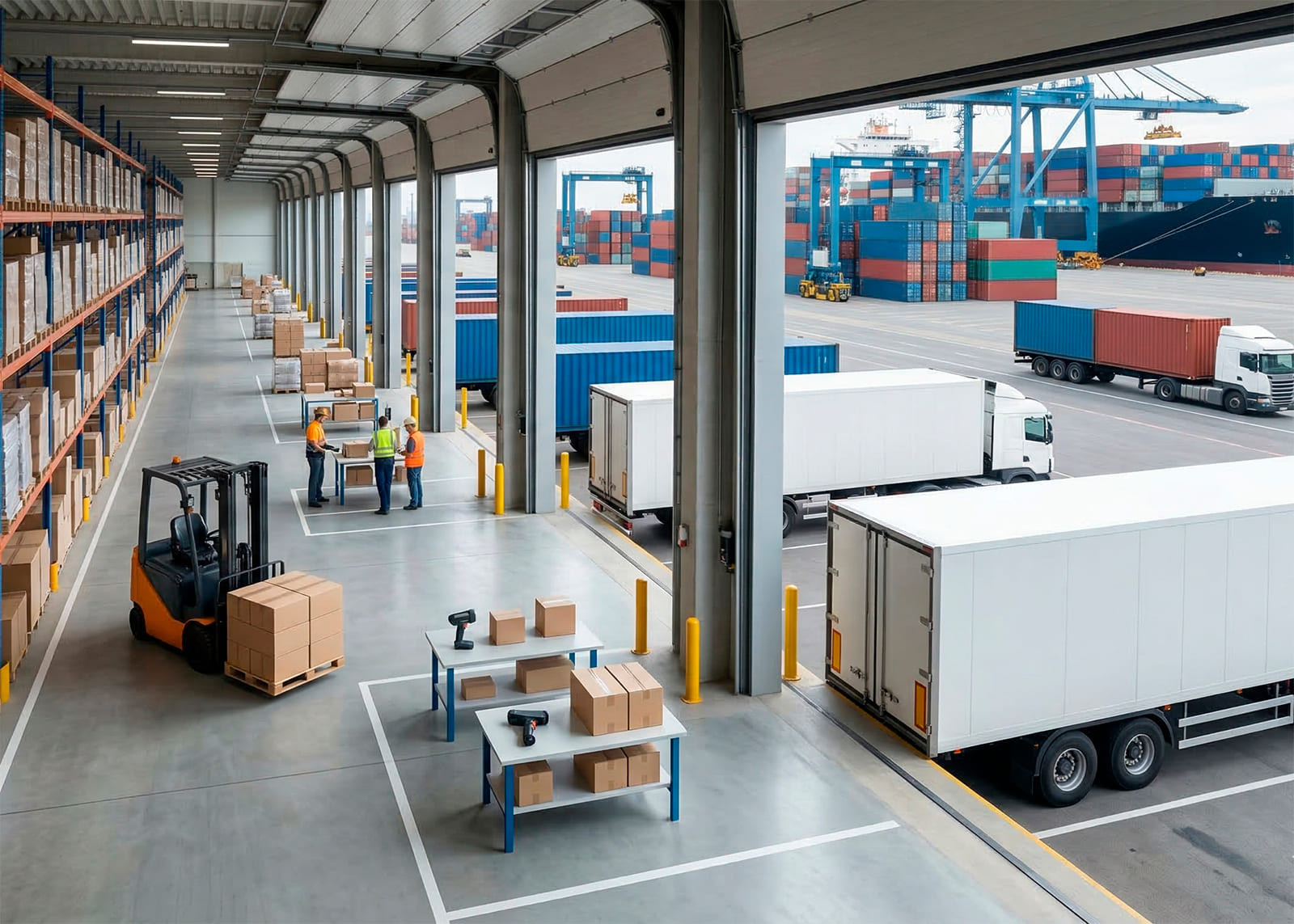
Key Points About WMS and TMS
WMS and TMS are not an additional digital layer for convenience, but core infrastructure for managing the physical flow of goods.
WMS manages warehouse operations: receiving, putaway, storage, picking, packing, and shipping.
TMS manages transportation: routes, transport modes, service providers, execution, statuses, and freight costs.
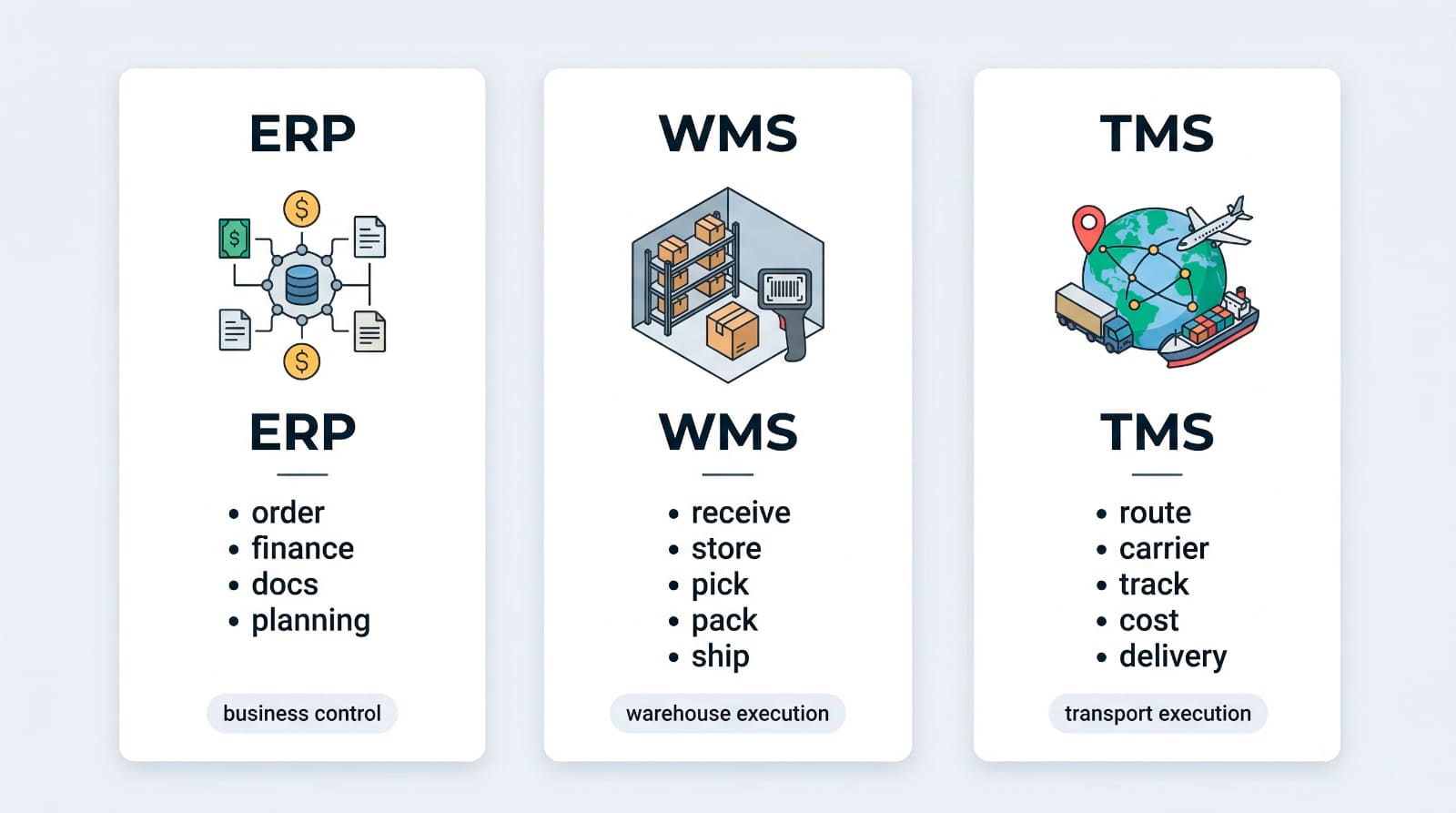
This is especially important in international logistics because disruptions typically do not occur at a single point. They arise at the interfaces between warehouses, transportation, terminals, customs procedures, and service providers. Without a management system, a company can see individual events but cannot manage the entire chain as one process. ERP therefore remains necessary but insufficient: it records orders, procurement, documents, and financial transactions, but it does not replace operational management of warehousing and transportation.
In recent years, this challenge has become much more closely tied to economics. According to UNCTAD data, global maritime trade increased to 12.3 billion tons in 2023, while pressure on lead times, freight rates, and supply chain resilience intensified. Under these conditions, effective management of warehousing and transportation is no longer optional. It has become a direct factor in margins and service performance.
What is WMS in simple terms
WMS is a warehouse management system. Its purpose is not simply to show inventory balances, but to manage the physical movement of goods inside a warehouse: where they should be put away, where they should be picked from, in what sequence orders should be assembled, and how the location, lot, shelf life, and status of each unit should be controlled.
Put simply, WMS turns a warehouse from a collection of people, zones, and manual activities into a controlled operating system. The broader the SKU range, the higher the throughput and order volume, and the stricter the accuracy requirements, the faster a warehouse without WMS becomes dependent on Excel, informal agreements, and employees' memory.
What is TMS in simple terms
TMS is a transportation management system. It is used to plan, execute, and control cargo transportation by road, air, sea, or through a multimodal combination. In international logistics, this means not simply viewing a tracking status, but managing routes, legs, service providers, freight rates, documents, exceptions, and delivery timelines.
Put simply, TMS helps a company do more than just dispatch freight. It helps move cargo through a controlled transportation scenario. When shipment volumes increase, several countries are involved, and multiple carriers and transport legs are used, manual coordination quickly becomes expensive: predictability declines, time losses increase, and the true end-to-end transportation cost becomes difficult to calculate accurately.
Why these systems are critical in international logistics
International logistics has become too volatile to manage as a collection of one-off operations. Routes are longer, there are more handover points, and expectations around timing, visibility, and compliance are higher. As a result, WMS and TMS are no longer relevant only to large retail networks and 3PL providers. They are increasingly important for any company where warehousing and transportation have a material impact on margins, service levels, and supply chain resilience.
| System | Primary responsibility | Where the benefits appear |
| WMS | Warehouse operations | Inventory accuracy, faster order picking, fewer errors |
| TMS | Transportation management | Route selection, freight rate control, visibility, and execution |
| ERP | Finance and accounting | Orders, procurement, documents, and management processes |
What WMS and TMS are and why they are often confused
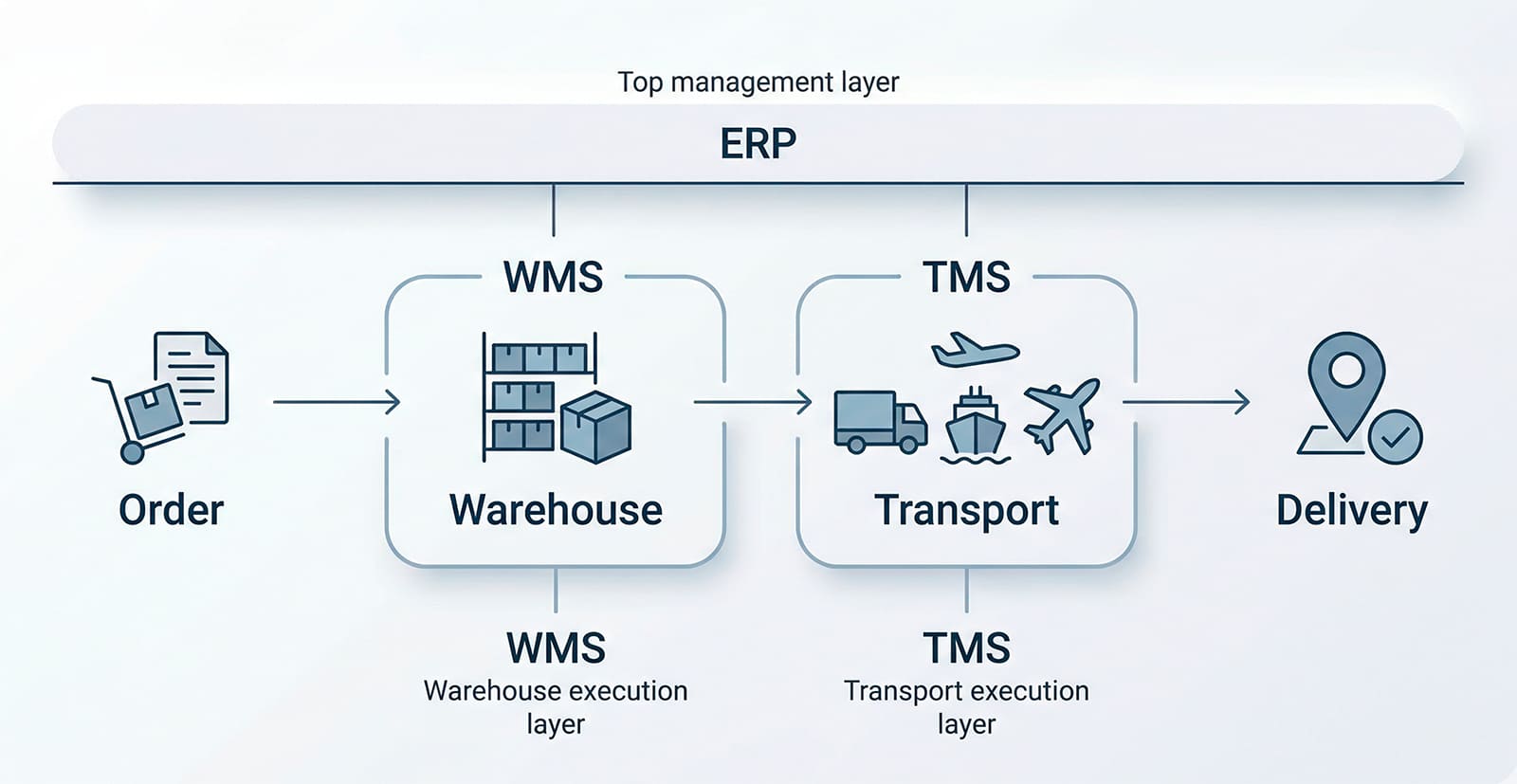
The confusion has a simple explanation: all three system categories work with the same business flow, but at different levels. ERP sees the order and its financial and accounting logic. WMS sees warehouse operations. TMS sees cargo movement between locations. When a company operates for a long time without clearly separating these roles, it may start assuming that "we already have accounting, so we do not need separate systems." This is not a terminology issue. It is an architecture problem.
WMS as a warehouse management system, not just an inventory record
A common mistake is to treat WMS as an advanced warehouse inventory database. In practice, WMS manages not just inventory figures but the sequence of warehouse activities. It defines putaway logic, creates picking routes, controls statuses, supports scanning, and manages lots, locations, and real-time operations. This is why the core functionality of WMS includes not only data storage but also receiving, putaway, picking, replenishment, packing, and shipping.
This is the boundary between "we know the product is somewhere in the warehouse" and "we control where it is stored, who is handling it, and when it is actually ready to ship." In international logistics, that distinction is critical. A warehouse error can quickly turn into a missed pickup window, vehicle detention, and a disrupted onward transport leg.
TMS as a transportation management system, not just shipment tracking
The second common mistake is reducing TMS to status tracking. Tracking is only one layer of the system. A full TMS operates earlier and at a deeper level: it supports route selection, carrier sourcing, shipment consolidation, freight rate calculation, transportation execution, freight invoice reconciliation, and exception management. Industry definitions describe TMS as a system for managing the movement of physical goods by road, air, sea, or combinations of transport modes, including route optimization and support for global transportation.
Put simply, TMS is not about displaying an attractive map on a screen. It is about making transportation decisions manageable. A company without TMS usually learns about a problem after the fact. A company with TMS can identify earlier where a risk is developing, what it may cost, which service provider is involved, and how it could affect the delivery commitment made to the customer.
Why ERP, WMS, and TMS do not replace one another
These systems work alongside each other, but they do not substitute for one another.
- ERP records the business event: order, procurement, financial processes, documents, and management accounting.
- WMS manages the physical warehouse operation: where the product is stored, how it is picked, and when it is actually ready to ship.
- TMS manages the physical movement of freight: how cargo moves between locations, who transports it, what it costs, and what happens in transit.
Mature international logistics operations therefore almost never rely on ERP alone. ERP is essential as the overall business backbone, but without WMS and TMS it does not address the most expensive operational risks: picking errors, inventory discrepancies, missed shipping windows, poor route visibility, and manual coordination between the warehouse, carrier, and customer.
Where OMS fits within ERP, WMS, and TMS architecture
OMS, or Order Management System, manages the lifecycle of an order from receipt through fulfillment, delivery, and returns. In an expanded ERP, OMS, WMS, and TMS architecture, OMS coordinates order fulfillment logic, while WMS manages activities within the warehouse and TMS manages transportation between locations.
What distinguishes it from ERP is its focus on order execution across a distributed network. ERP records the commercial and accounting framework, while OMS helps determine which warehouse, store, 3PL facility, or other node should fulfill the order, how items should be allocated when inventory is constrained, and how changes should be synchronized as fulfillment progresses. IBM defines OMS as a digital system for managing the order lifecycle, including order entry, inventory management, fulfillment, and after-sales service.
In B2C, this architecture is particularly common in e-commerce and omnichannel retail. In B2B, it becomes useful when an order can be fulfilled from multiple warehouses, through different inventory owners, or by contract logistics providers. The practical benefit is that fulfillment decisions are not made manually for every order, but according to a consistent logic based on availability, priorities, and constraints.
The trade-off is the requirement for high-quality, synchronized data. If OMS receives outdated inventory or status information from ERP and WMS, it may formally select the optimal fulfillment scenario even though that scenario no longer reflects actual product availability. A separate OMS is therefore justified primarily where order fulfillment complexity has genuinely exceeded what the ERP and WMS combination can manage.
How WMS works in real warehouse operations
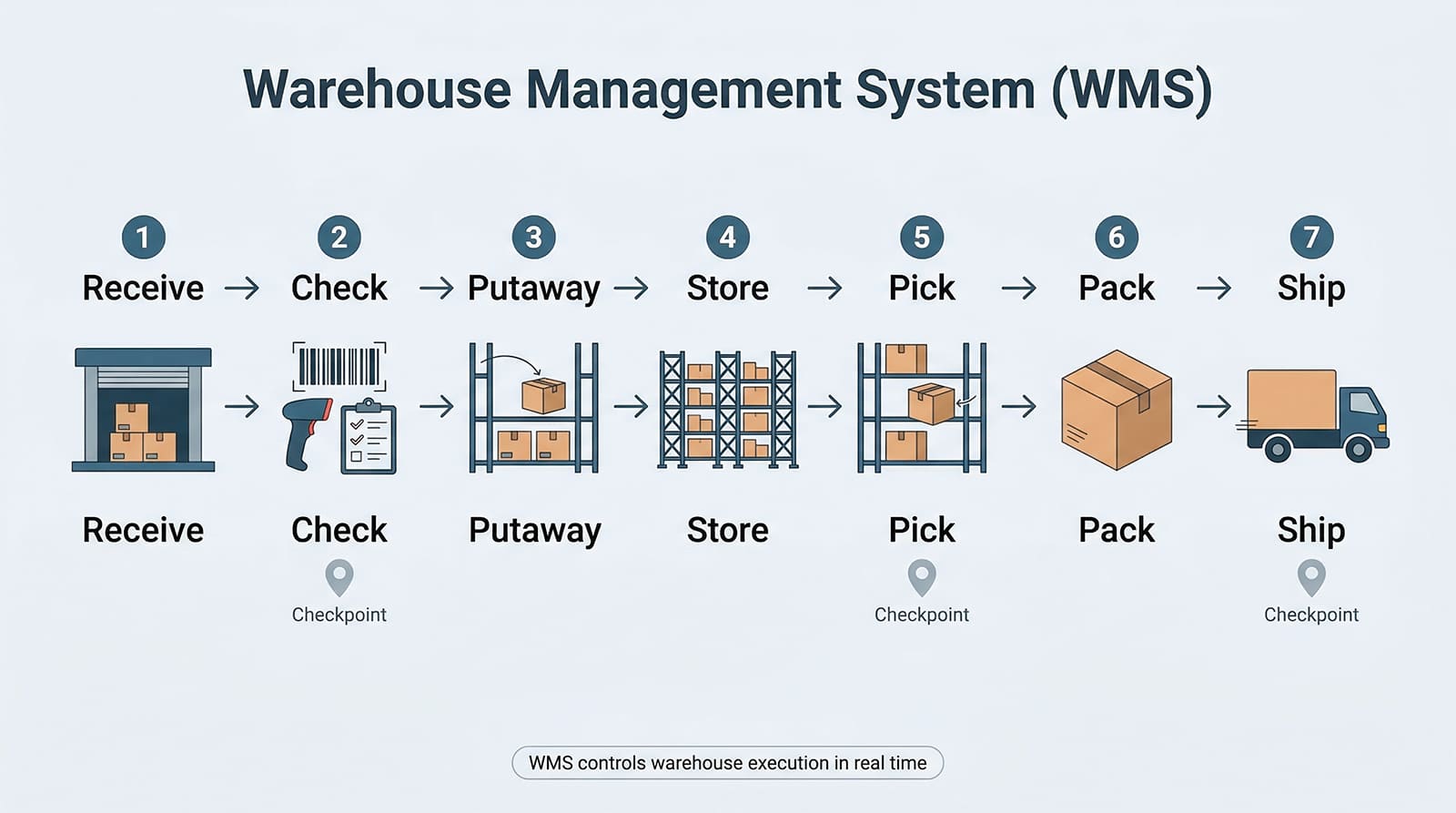
WMS creates value not in reports, but at the point where the warehouse stops depending on employees' memory and local informal agreements. The system defines the sequence of operations, records product status in real time, and links physical movement to a specific storage location, lot, task, and operator.
This is particularly important in international logistics because a warehouse error rarely remains an internal warehouse problem. Incorrect putaway, product mix-ups, an order that is not ready for dispatch, or missing lot information can quickly result in a missed pickup window, vehicle detention, a temperature excursion, or disruption of the next leg in a multimodal supply chain.
Receiving, putaway, and location-based storage
During receiving, WMS records incoming goods, updates inventory, and directs each unit to an appropriate storage area. In practice, this means the system considers cargo characteristics, turnover, available locations, and storage rules instead of leaving every decision to the warehouse shift. This is the core value of WMS: it turns product placement from a series of local decisions into a controlled warehouse operating logic.
Location-based storage plays a structural role here. When goods are linked not to an approximate area but to an exact storage location, the warehouse can maintain higher accuracy, find products faster, and safely redistribute inventory across zones, facilities, or inventory owners.
Inventory, lot, and traceability management
A good WMS manages not only whether a product is in stock, but also its condition and identity. It shows exactly what is stored, where it is located, which lot or serial number it belongs to, when it was received, and in what sequence it should be picked.
For industries where expiration dates, temperature control, lot origin, and claims management matter, this is no longer a convenience but a basic requirement for operational control. In these cases, traceability means more than an internal system note. It means being able to connect a specific unit, lot, or event with the movement of goods throughout the supply chain. This is why traceability is increasingly becoming not merely a local warehouse function, but part of end-to-end visibility and data exchange between supply chain participants.
Picking, packing, and shipping
During picking, WMS defines the picking logic based on waves, zones, lots, tasks, or other rules suited to the warehouse operating model. This reduces disorder during peak periods, cuts unnecessary employee travel, and makes order assembly more predictable.
The role of WMS does not end there. The system takes the order through to actual readiness for handoff to transportation: it helps verify picking accuracy, supports packing workflows and labeling, and transfers relevant data to the transportation system. This is where the critical interface between warehousing and transportation appears. The order must not simply be picked. It must be ready to ship under the correct transportation scenario.
Where WMS reduces losses, picking errors, and manual work
The most visible impact of WMS comes from reducing common warehouse losses:
- fewer discrepancies between physical and system inventory;
- lower risk of product mix-ups and incorrect shipments;
- faster cycle counting and product location;
- better control of lots, serial numbers, and expiration dates;
- easier scaling across multiple warehouses or within a 3PL environment.
How WMS differs from WES and WCS
WMS manages warehouse processes and inventory, WES coordinates the execution of warehouse tasks in real time, and WCS directly controls automated equipment. The higher the level of warehouse automation and robotics, the more important it becomes to distinguish between these management layers.
| System | Primary function | When it is especially useful |
| WMS | Inventory, receiving, putaway, picking, packing, and shipping | Warehouses with a broad SKU range, high operational intensity, or strict traceability requirements |
| WES | Prioritizing and coordinating task execution between people and automation | High operational intensity and extensive warehouse automation |
| WCS | Controlling conveyors, sorters, AS/RS, robots, and other equipment | Automated warehouses and distribution centers |
Unlike WMS, which determines what should happen to goods and in what sequence, WES operates closer to the point of execution and balances task flow based on the current workload of warehouse zones, employees, and automated resources. WCS sits one level lower and sends commands directly to conveyors, sorters, automated storage and retrieval systems, and robotic equipment. MHI notes that the boundaries between WMS, WES, and WCS partially overlap, so functionality can vary between solutions.
The practical value of a separate WES or WCS emerges at large automated facilities where WMS alone is no longer sufficient to coordinate equipment and thousands of simultaneous tasks in real time. In a conventional warehouse, however, another software layer can increase integration complexity, the number of potential failure points, and maintenance costs. The decision should therefore be based not on the number of systems, but on the actual warehouse architecture and level of automation.
How TMS works in international transportation
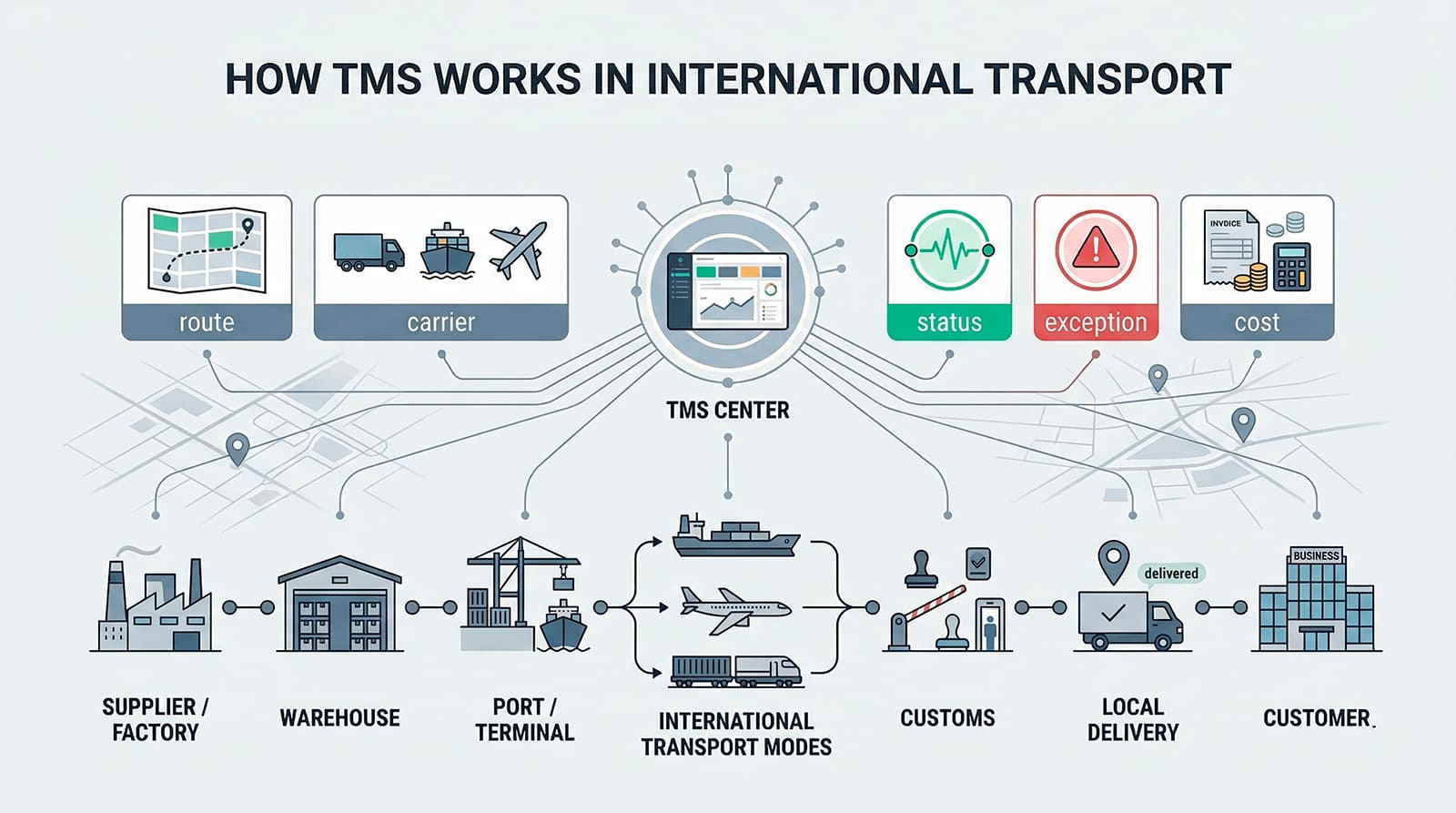
In international logistics, TMS is not simply a way to see cargo on a map. Its purpose is to connect transportation planning, execution, tracking, and control within a single environment where the company manages not just an individual shipment, but the entire transportation model: route, mode, service providers, freight rates, documents, exceptions, and SLA performance.
This is fundamental for international supply chains because there is rarely a single execution point. Ports, terminals, air legs, final-mile trucking, transshipment, consolidation, customs events, and schedule deviations should not live in email threads. They should be part of a controlled operational process.
Transportation planning, route, mode, and carrier
TMS planning begins well before the cargo starts moving. The system compares transport modes, routes, transit times, freight rates, restrictions, and delivery windows. This allows the company to choose not simply a carrier, but a delivery scenario that is acceptable in terms of time, cost, and risk.
This is particularly important in international multimodal transportation, where the cheapest route is not always the best and the fastest route is not always feasible. A capable TMS allows alternatives to be compared in advance instead of forcing the company to explain afterward why the shipment moved through an inefficient routing.
Transportation execution, booking, documents, statuses, and exceptions
Once the transportation scenario has been selected, TMS moves into execution. At this stage, the system manages shipment creation, confirmations, carrier interactions, routes, statuses, events, and exceptions.
In international logistics, this means TMS helps manage not only shipments that proceed as planned, but also problematic scenarios. Terminal delays, shifted delivery windows, misalignment between transport legs, route changes, or missing carrier confirmations stop being fragmented email exchanges and become managed operational events.
The point of this environment is not simply to collect statuses, but to identify deviations earlier and support faster decisions. This is why the value of TMS lies not in observing transportation, but in managing events and reducing the cost of disruptions.
Cost control, freight rates, accessorial charges, and freight audit
One of the most underestimated functions of TMS is control over the actual cost of transportation. The system is useful not only for selecting routes, but also for comparing freight rates, validating charges, controlling accessorial fees, reconciling freight invoices, and completing financial settlement for shipments.
This is critical in international logistics because major losses are often hidden not in the base freight rate, but in adjustments, surcharges, unauthorized services, detention, and manual invoice reconciliation. Without TMS, a company sees the total transportation spend. With TMS, it can better understand the cost structure and identify earlier where margin erosion begins.
Cargo visibility across a multimodal supply chain
True visibility in international transportation is not the presence of a single tracking number. It is the ability to understand where the cargo is, what is happening to it, which stage has already been completed, who currently holds responsibility, and which event should happen next.
This is why TMS becomes a tool for managing complex transportation architecture rather than simply a tracking system. It connects ports, terminals, ocean legs, air freight, trucking, transshipment, execution events, and SLAs within one environment where deviations can be managed rather than merely observed.
How TMS differs from a Supply Chain Control Tower
TMS manages transportation planning and execution, while a Supply Chain Control Tower combines data from TMS, WMS, ERP, and external sources to provide a view across the entire supply chain and highlight the most critical exceptions. A Control Tower does not replace TMS. It sits above operational systems as a layer for end-to-end visibility and decision support.
The difference becomes especially clear in complex international supply chains. TMS may show a delay affecting a particular shipment, but a Control Tower should connect that delay to the order, inventory, customer SLA, other routes, and potential consequences across the wider network. IBM describes a Supply Chain Control Tower as a connected environment of data, key performance indicators, and events that helps identify, prioritize, and resolve critical supply chain issues.
The practical value of this approach appears in companies operating multiple warehouses, carriers, countries, and data sources. But a Control Tower cannot create transparency from poor data. If WMS, TMS, and ERP provide inconsistent statuses, or if the company has not defined who should respond to particular exceptions, the result may be an expensive monitoring dashboard without any significant improvement in supply chain management.
What changes when WMS and TMS work together
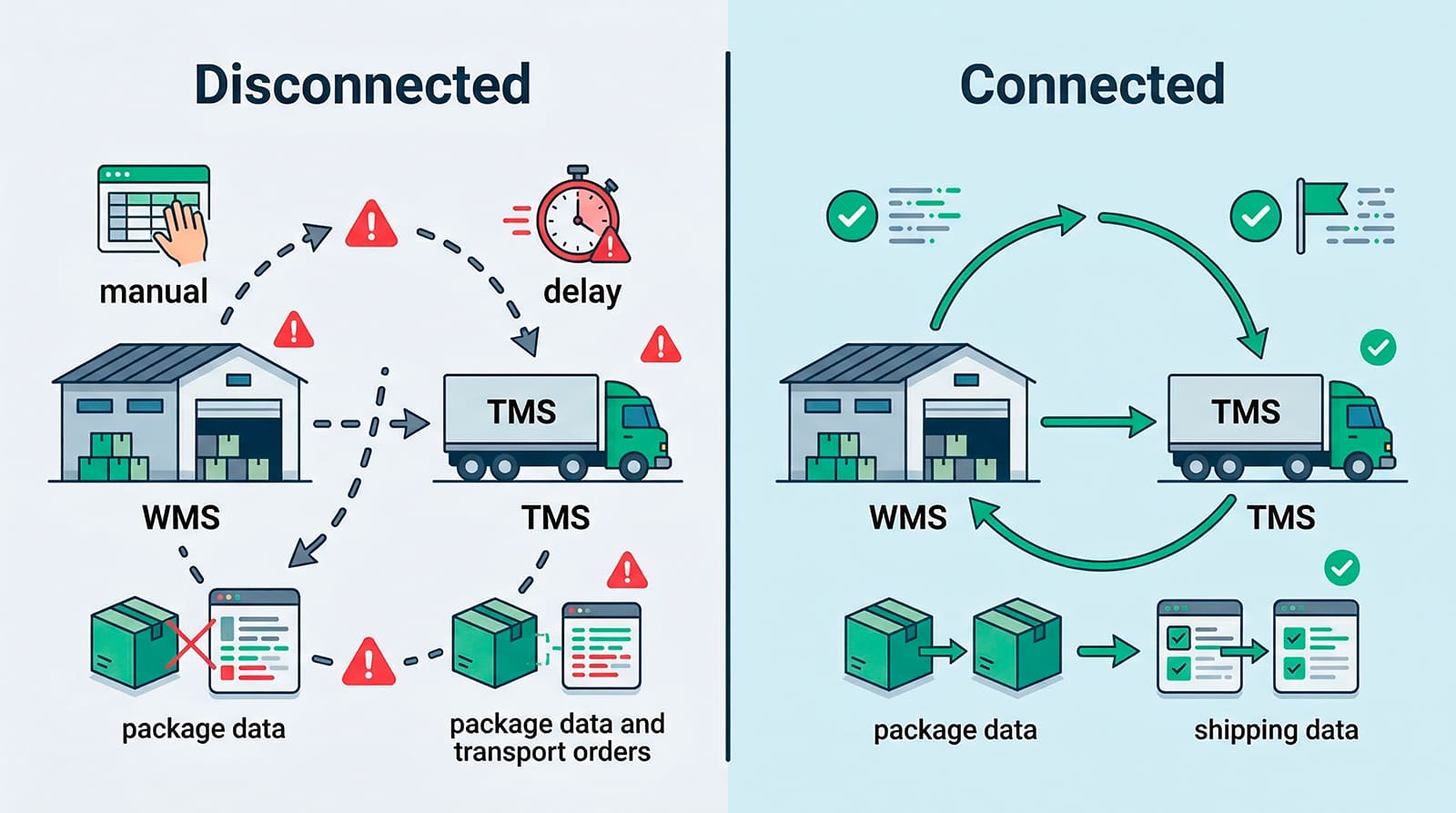
When WMS and TMS operate in isolation, each system improves only its own area. The warehouse becomes more accurate and faster. Transportation becomes better planned and controlled. But the greatest benefit appears not within those areas, but at the interface between them. That is where time, accountability, and operational control are most often lost.
YMS at the interface between warehouse and transportation
YMS, or Yard Management System, manages the area between the transportation network and the warehouse: truck arrivals, queues, parking positions, gates, docks, and the movement of trailers or containers around the facility. In effect, YMS closes the physical gap between what TMS knows about arriving transportation and what WMS knows about the warehouse's readiness to receive or ship cargo.
It differs from WMS because its main area of control is outside warehouse storage locations, and from TMS because it does not plan the entire international transportation process. SAP describes Yard Management as an extension of warehouse management beyond the physical walls of the facility, including vehicle check-in and check-out, assignment of gates and waiting areas, and recording the start and completion of loading or unloading.
The practical value of YMS appears at distribution centers, terminals, and large warehouses with heavy vehicle traffic where gate queues and detention have become a separate source of loss. With a low volume of arrivals, however, a dedicated system may be excessive. Yard management functions can often be handled within WMS or another logistics solution. A standalone YMS makes sense when the yard and docks have themselves become an operational bottleneck.
Warehouse and transportation stop operating as two disconnected environments
Without WMS-TMS integration, the warehouse may consider an order ready while the transportation function still lacks accurate information about pickup, time windows, routing, or shipment type. Both sides may formally be doing their jobs, yet the supply chain can still fail.
When the systems are connected, shipping readiness, cargo parameters, handling units, and the transportation scenario no longer exist in two different versions of reality. This reduces gaps between the actual readiness of an order and its actual dispatch.
A single logic emerges from order to shipment
WMS-TMS integration creates a single data flow: goods are received, put away, picked, packed, confirmed as ready for shipment, transferred into the transportation process, and dispatched according to the selected scenario.
This significantly reduces manual coordination between the warehouse, transportation department, 3PL provider, and carrier. Instead of constant clarification about what is actually ready, the business gains a consistent sequence of statuses.
The cost of errors at the warehouse-transport interface decreases
The most expensive errors often occur not inside the warehouse or on the road individually, but between the two. An incorrectly packed order, inaccurate volume, unconfirmed readiness, a missed time window, document discrepancies, or errors in handling units can lead to additional charges, detention, rescheduling, and poorer service.
When WMS and TMS exchange accurate events and data, these errors are detected earlier and cost less to resolve.
International supply chain control improves
Individually, WMS and TMS provide local efficiency. Together, they reduce blind spots between "the goods are ready to ship" and "the cargo has actually departed under the correct transportation scenario."
In practice, this means a more reliable transition from warehouse operations to international transportation, fewer gaps in status information, and lower losses from manual coordination. IBM also emphasizes that visibility problems often arise not because data does not exist, but because of barriers between applications, process participants, and connected operations. This is why WMS-TMS integration matters not merely as IT architecture, but as a way to eliminate the gap between warehousing, transportation, and actual supply chain execution.
Where businesses see financial returns, not just a better interface
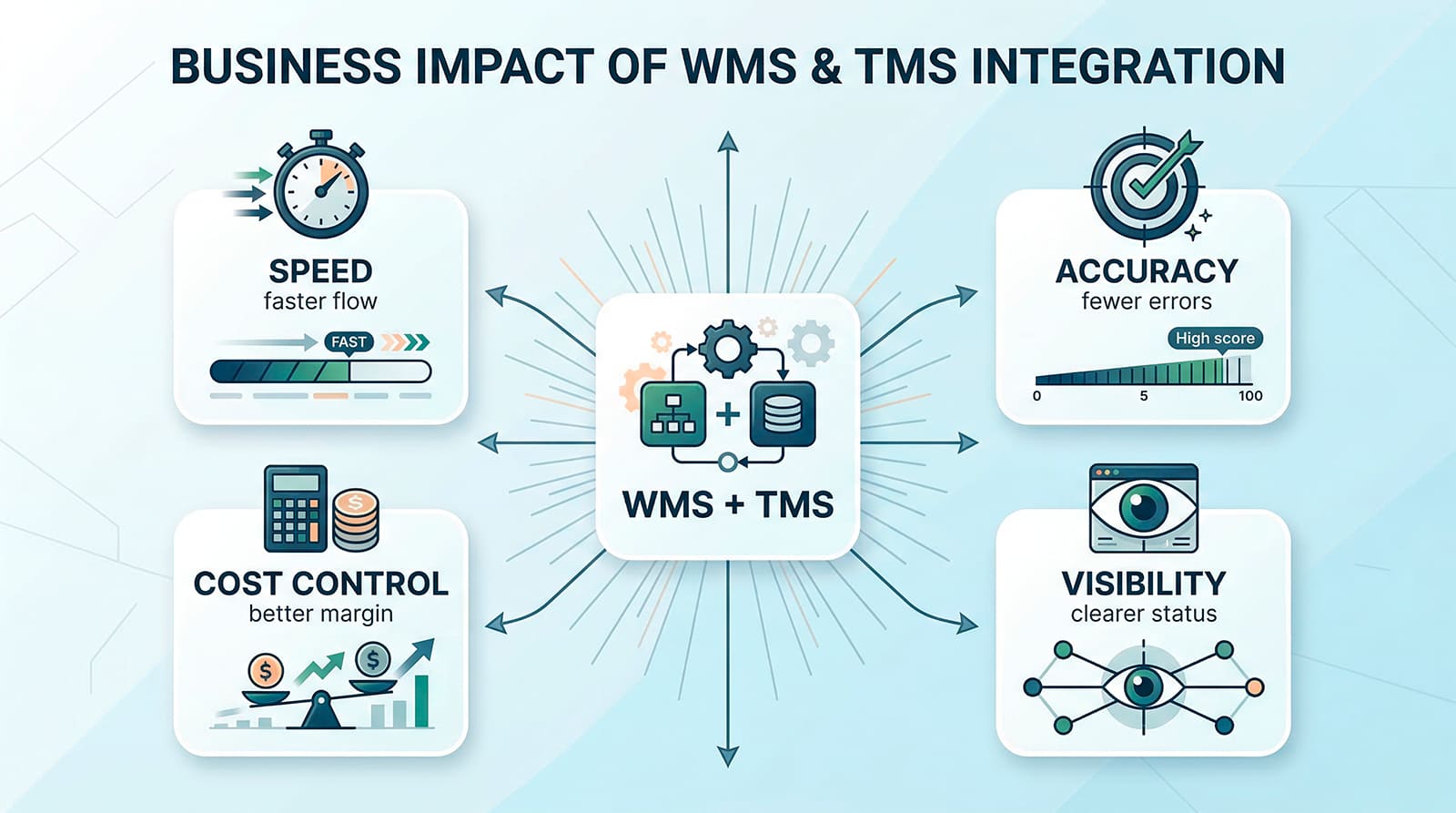
The value of WMS and TMS is not reflected in the interface or the number of automated screens. It appears where the business stops losing money through manual coordination, inaccurate inventory, delayed responses to exceptions, and poor supply chain visibility.
This is why these systems should be evaluated not as IT projects, but as tools for reducing operational losses and improving control. Gartner notes that 21% of supply chain leaders identify poor data quality as the biggest barrier to adopting analytics and AI, while 33% cite lack of trust in data. This is an important signal: without a reliable operational backbone, a company cannot confidently scale either analytics or automation.
Operational impact, fewer errors, faster execution, and less manual work
Operational benefits appear where the system removes routine work and makes processes repeatable. In warehousing, this means more accurate receiving, location-based storage, controlled picking, and less dependence on employees' tacit knowledge. In transportation, it means clearer routing, predefined carrier management logic, and structured handling of exceptions rather than emergency responses after a failure.
Put simply, WMS and TMS reduce the share of operations that previously depended on memory, email threads, and local spreadsheets. This reduces employee workload, lowers the probability of errors, and makes processes more scalable.
Financial impact, tighter cost control, and fewer losses from exceptions
The financial impact is often underestimated because it is spread across several cost categories. Yet this is often where WMS and TMS deliver the fastest returns.
WMS reduces losses from product mix-ups, unnecessary movements, inventory discrepancies, and shipping errors. TMS provides tighter control over freight rates, accessorial charges, exceptions, and manual freight cost reconciliation. As a result, the company understands not only how much logistics cost overall, but also where unnecessary expenses originated.
It is especially important that the cost of exceptions is higher in international logistics than in domestic operations. An error in cargo volume, readiness status, lot data, or the shipping window can easily result in detention, a missed transport leg, additional terminal services, or loss of an agreed freight rate. These systems therefore create value not only by accelerating processes, but also by identifying expensive exceptions earlier.
Customer impact, more accurate delivery commitments and better service
Customers rarely perceive the value of WMS and TMS as "our supplier uses a modern system." They experience it differently: fewer disruptions, higher predictability, clearer order status, and a smaller gap between promised and actual delivery times.
This is particularly important in international shipments, where customers need more than general reassurance. They need a clear understanding of what is happening to their cargo at key stages. According to UNCTAD's Digital Economy Report 2024, business e-commerce sales across 43 countries increased by almost 60% between 2016 and 2022, reaching $27 trillion. The greater the share of digital sales and distributed orders, the more costly poor fulfillment accuracy becomes.
Supply chain resilience and risk reduction
Supply chain resilience is not abstract flexibility. It is the ability to identify exceptions earlier, make decisions faster, and maintain control during external disruptions. When warehousing and transportation are managed semi-manually, companies discover problems too late and typically compensate with buffer inventory, expedited freight, and manual escalation.
When inventory, status, and transportation data are distributed across different systems and participants, supply chain visibility declines and the cost of errors rises. Under these conditions, businesses are more likely to protect themselves with excess inventory, expensive transportation solutions, and manual coordination instead of effective exception management.
Companies using WMS and TMS do not become immune to disruption, but they are better able to withstand volatility without a sharp increase in costs. They have better visibility into the status of lots, shipments, and execution stages, allowing them to identify earlier when inventory should be reallocated, routes changed, or service providers switched.
| Area | Without WMS/TMS | With WMS/TMS |
| Inventory | Discrepancies and manual reconciliation | Higher accuracy and traceability |
| Shipping | Picking and status errors | Step-by-step execution control |
| Transportation | Reactive management | Planning and exception management |
| Analytics | Excel and manual consolidation | KPI, SLA, cost, and root-cause analysis |
Risks and limitations of WMS and TMS implementation
Having a system does not automatically make logistics operations mature. In fact, implementation may fail to deliver the expected benefits and can even lock existing problems into a more rigid structure. Gartner predicts that by 2028, 60% of supply chain digital adoption initiatives will fail to deliver their promised value because of insufficient investment in learning and development. It is an uncomfortable but useful benchmark: failures do not come only from technology. The operating model for adopting that technology can fail as well.
Poor master data and weak process discipline
If a company lacks reliable master data for products, storage units, statuses, addresses, carriers, delivery points, and exception-handling rules, the system will not fix the situation on its own. It will operate on poor inputs and simply reproduce errors faster.
McKinsey notes that poor data quality and insufficient technology support remain common barriers to implementing master data management systems.
Automating chaos instead of automating a process
One of the most common mistakes is automating a disorganized process without first defining how it should actually work. If the warehouse lacks a clear location strategy, transportation lacks defined statuses and SLAs, and departments have not assigned a process owner, a new system will not create order by itself.
It will simply accelerate the movement of disorder, making it less visible at first but more expensive at scale.
Integration problems with ERP, 3PL providers, carriers, and marketplaces
In practice, the most difficult area is not the WMS or TMS interface, but the system's ability to function within the real business ecosystem. ERP, warehousing, transportation, 3PL providers, and carriers need to be connected, and in some cases marketplaces or counterparties' systems must also be integrated.
If the integration logic is weak, data begins to diverge between participants and systems: statuses are lost, events are recorded with different delays, and the unified view of execution breaks into separate fragments. The company then sees not the supply chain as a single process, but several incomplete versions of the same operation.
This is why international logistics requires not only automation of individual functions, but also compatibility of data, statuses, and events across the entire supply chain.
Resistance from warehouse, transportation, and local teams
Employee resistance is not a secondary issue. It is one of the key implementation risks. Any WMS or TMS changes the mechanics of daily work: who enters data, who confirms statuses, who owns an exception, and who can no longer resolve an issue with a phone call.
Resistance therefore does not necessarily arise because people oppose technology. It often arises because the system makes the process more transparent and more disciplined.
Why buying a system does not equal digital maturity
Digital maturity does not begin with purchasing a software license. It begins with controlled processes, high-quality data, and a clear architecture of accountability. If the company lacks a proper warehouse location strategy, defined status rules, a unified carrier master, SLAs, and process ownership, the system will not solve the problem. It will simply reproduce disorder more quickly.
This is the uncomfortable reality that companies often try to avoid during solution selection.
Which companies need WMS first
WMS is not necessary for every company. But there are business models where the absence of a proper warehouse management system quickly begins to affect costs, service, and operational resilience. These are usually companies where the warehouse has stopped being merely a storage location and has become a high-speed operating node with a broad SKU range or complex traceability requirements.
E-commerce and omnichannel operations
In e-commerce and omnichannel operations, WMS becomes critical relatively early. Transaction density is higher, fulfillment cycles are shorter, and customer expectations for accuracy and transparency are more demanding. The more orders and SKUs a company handles, the faster a warehouse without WMS begins to lose control.
Against the backdrop of digital commerce growth, this is no longer a niche issue. UNCTAD notes that 2.3 billion people made online purchases in 2021, an increase of 68% from 2017. At this level of demand, warehouse discipline is no longer merely an internal warehouse concern. It becomes part of customer service.
3PL and contract logistics
For 3PL providers, WMS is almost always a core system. They need to manage multiple inventory owners, different handling rules, SLAs, and allocation of warehouse resources at the same time.
Manual processes break down particularly quickly in this environment. The risk of mixing inventory, losing statuses, and creating disputes over responsibility rises sharply. If a warehouse serves multiple clients, WMS is needed not simply to increase speed, but to maintain operational control.
FMCG, distribution, and high-turnover networks
In FMCG and distribution, the main problem is not simply the volume of goods, but the speed at which they move and how quickly any error scales. High turnover, pallet handling, promotional campaigns, frequent inbound shipments, and strict shipping windows create an environment where a warehouse without controlled picking, putaway, and execution-confirmation logic becomes a bottleneck.
Companies with complex lot, serial number, or shelf-life requirements
When a business handles lots, serial numbers, manufacturing dates, expiration dates, temperature requirements, or traceability obligations, WMS becomes more than a productivity tool. It becomes a control system.
Traceability requires linking physical and information flows through identification, event capture, and data exchange. For goods subject to stricter control requirements, identification at the lot, serial number, or individual item level becomes an essential operating principle.
Which companies benefit most from TMS
TMS delivers the greatest value where transportation has stopped being a simple delivery function and has become a distinct source of cost, risk, and loss of control. The more transport legs, service providers, countries, tariff structures, and exceptions a company has to manage, the faster manual coordination begins to lose to systematic transportation management.
This is especially evident in international logistics, where even a single shipment may involve several transport modes, terminal operations, and transfers of responsibility between multiple supply chain participants.
Importers and exporters with regular international shipments
For importers and exporters, TMS becomes useful not when there is one occasional shipment, but when shipments are recurring and depend on the quality of the transportation scenario.
Regular imports or exports quickly accumulate the same problems: unstable transit times, difficult route selection, inconsistent freight rates, manual reconciliation of transport stages, and poor exception visibility. At this point, TMS turns transportation from a chain of manual agreements into a controlled process with planning and execution management.
Companies using multiple carriers and transport modes
If a business works with multiple carriers and several transport modes, TMS usually begins delivering value particularly quickly. Without it, the company constantly compares conditions manually even though they may not be directly comparable, and identifies problems affecting individual legs, connections, and delivery schedules too late.
Coordination errors accumulate especially quickly in this model. Freight rates are compared inconsistently, operating terms are stored in email correspondence, and exceptions become visible only after they have already affected delivery time or cost. TMS is therefore needed not only for transportation control, but also to manage carriers, routes, and execution terms within one environment.
Businesses with a high share of transportation costs
When transportation represents a significant share of total cost or has a major impact on margin, TMS stops being a matter of convenience and becomes a matter of financial discipline.
Freight rate management, accurate charge calculation, exception control, and final financial settlement of transportation become critical. Without a systematic environment, transportation costs quickly become fragmented across base freight rates, additional services, adjustments, detention, and manual reconciliation. TMS helps consolidate these costs into a manageable model and identify earlier where losses begin.
Organizations where status and exception visibility is critical
Some businesses are affected less by average transportation cost than by the cost of uncertainty. If a company must know where the cargo is, who is responsible for the current stage, which event has already occurred, and where an exception has emerged, TMS can deliver disproportionately high value.
IBM states that supply chain control environments and visibility are not intended simply to provide an attractive dashboard, but to support exception management, collaborative responses to disruption, and faster decision-making around unplanned events. (IBM link from the source article)
How to tell when a business has reached its limit without WMS or TMS
Companies usually decide to implement WMS or TMS too late, once costs, errors, and dependence on individual employees are already increasing. It is therefore more important to identify early signs that manual management can no longer cope with the scale, complexity, or international scope of the operation.
With poor supply chain visibility, a company loses a unified view of shipments, orders, and invoices, struggles to manage unplanned events, and can no longer properly analyze the causes of disruptions.
Signs that a warehouse already needs WMS
A warehouse often reaches its limit before management is prepared to acknowledge it. The most reliable indicator is when operations are still running, but depend increasingly on specific employees' experience, manual checks, and constant clarification.
Common signs include:
- inventory counts regularly reveal discrepancies;
- employees know where products are from memory rather than from the system;
- finding an item or lot depends on a specific shift;
- location-based storage is either nominal or inconsistent;
- order picking requires additional checks and manual coordination;
- lots, serial numbers, or expiration dates require special effort to track instead of being controlled by default.
Signs that transportation already needs TMS
In transportation, the limit usually appears through loss of control rather than delays alone. Shipments may still be moving, but management is already weakening: it becomes harder to compare routes, calculate total transportation cost, and quickly explain the causes of disruptions.
Common signs include:
- shipment statuses are collected manually from emails, messaging apps, and phone calls;
- the cause of a delay cannot be explained quickly;
- it is difficult to calculate the actual route cost including additional charges;
- carrier selection depends on habit rather than transparent criteria;
- exceptions are discovered late, after delivery time or the agreed freight rate has already been lost;
- international transportation operates as a chain of local manual actions rather than a single managed process.
Signs that it is time to integrate both environments
A separate level of maturity appears when the problem is no longer only warehousing or only transportation, but the gap between the two. This is often the most expensive part of the operation because each side may formally be functioning while the supply chain still fails.
Signs that the integration model has reached its limit include:
- shipments depend on key individuals and Excel;
- the warehouse considers an order ready, but transportation cannot pick it up correctly;
- there is no reliable traceability of lots and shipments from storage location through transportation;
- cargo parameters, packaging data, and statuses differ between systems;
- the root cause of disruptions is lost between warehouse operations, the carrier, and planning;
- warehouse and transportation KPIs exist, but there is no end-to-end view of order execution.
How to choose WMS and TMS for international logistics
The main mistake during solution selection is looking for the best-known system rather than the architecture that best fits the process. This is especially risky in international logistics because success depends not only on functionality within a single application, but also on the system's ability to operate in a complex ecosystem involving ERP, 3PL providers, carriers, external warehouses, different legal entities, and multiple countries.
The selection process should therefore focus not on an attractive list of modules, but on whether the solution can support the company's actual supply chain model.
What to evaluate in WMS
When evaluating WMS, the focus should not be on abstract warehouse automation but on whether the system can handle the real complexity of operations. For an international business, this is particularly important when warehouses are shared, external ERP environments are involved, there are multiple inventory owners, or the company operates several warehouse facilities.
A capable WMS should work effectively not only in a single, monolithic warehouse model, but also in more complex operating environments involving multiple warehouses, different inventory owners, segregated inventory accounting, and external order systems. If the system struggles with this model, manual workarounds will quickly appear precisely where the business needs control most.
A short WMS checklist:
- location-based storage;
- lot and serial number management;
- scanning or RFID support;
- picking and replenishment logic;
- multi-warehouse capabilities, if genuinely required;
- segregation by inventory owner or legal entity where the warehouse is not operated as a single entity.
What to evaluate in TMS
When evaluating TMS, the focus should not be limited to shipment tracking. The full transportation management scope matters. If a system can display statuses but is weak in planning, carrier management, freight cost calculation, and execution control, it will quickly reach the limits of its usefulness.
A short TMS checklist:
- multimodal transportation;
- freight rate and tariff management;
- carrier management;
- status and cargo movement tracking;
- freight audit or carrier settlement;
- exception management and notifications;
- execution control across key milestones.
Which integrations are critical
International logistics requires both internal and external integrations. The system needs to connect with ERP, warehouse operations, and carriers, and in some cases with external order management systems, event-data providers, 3PL operators, and marketplaces.
If the system operates in isolation, visibility quickly fragments into several incomplete views.
Cloud, on-premises, or hybrid deployment
There is no universally correct answer. For some companies, the priorities are speed of scaling, flexible updates, and the ability to operate across a distributed partner network. For others, security requirements, non-standard integrations, or local infrastructure control are more important.
The real question is therefore not whether cloud is always better or on-premises deployment is more reliable, but where the company's main complexity lies: IT control or operational flexibility. In international logistics, a hybrid model often proves more practical than committing entirely to one side, because part of the operating environment already exists in external platforms and counterparties' networks.
Why process architecture matters more than a well-known vendor name
A well-known vendor cannot compensate for weak operational architecture. If a company has not defined statuses, roles, SLAs, master-data logic, and points of responsibility transfer, even a strong system will operate below its potential.
Conversely, a business with well-defined processes and strong data discipline has a better chance of generating value even from a less well-known solution. The key question when selecting WMS and TMS is therefore not "which brand should we buy?" but "which process must the system support without manual workarounds and constant exceptions to its own rules?"
How the role of WMS and TMS changed in 2024-2026
Between 2024 and 2026, the role of WMS and TMS changed significantly. They were previously often viewed as systems for local automation: one for warehousing, the other for transportation. That is no longer sufficient. International logistics has become less predictable, while the cost of delays, status gaps, and poor coordination has increased.
UNCTAD noted that by May 2025, tonnage through the Suez Canal was still approximately 70% below 2023 levels, while supply chains remained vulnerable amid volatile freight rates and persistent port disruptions. This is no longer a temporary anomaly. It is an operating environment in which manual management offers progressively fewer chances of achieving consistent results.
Growing requirements for supply chain visibility and resilience
The main change in recent years is the increasing demand not merely for automation, but for supply chain visibility and resilience. It is no longer enough for a business to know that goods are somewhere in transit or recorded as being in a warehouse. Companies need to see the status, stage, exception, and responsible party early enough to intervene.
This is why WMS and TMS are increasingly assessed not as separate applications, but as components of a resilience framework. DHL, in its material on supply chain diversification, directly links resilience with distributing operations across multiple countries, multiple sourcing channels, different transport modes, and parallel logistics scenarios. In practical terms, this means one simple thing: companies can increasingly no longer rely on a single route, one carrier, one warehouse scenario, or one spreadsheet. They need an operating environment capable of handling alternative legs, transshipments, network reconfiguration, and frequent exceptions without requiring the entire process to be rebuilt manually.
Shift from local automation to end-to-end orchestration
The second major shift is the move from local automation toward end-to-end orchestration. WMS and TMS are increasingly treated not as systems for isolated functions, but as components of a unified digital model for managing the supply chain.
Investment signals point in the same direction. The MHI and Deloitte industry report states that 55% of supply chain leaders are increasing investment in technology and innovation, while 60% plan to spend more than $1 million. The report also emphasizes that these investments are targeting supply chain visibility and resilience solutions.
This is an important shift. Previously, companies could automate warehousing and transportation separately and tolerate the gaps between them. Today, that approach is increasingly expensive. When a disruption occurs at the interface between multiple systems, service providers, and countries, a locally optimized function is no longer enough. Companies need orchestration of events, statuses, and decisions across the entire supply chain, not just within one facility.
How AI and machine learning enhance WMS and TMS
AI and machine learning do not replace WMS or TMS. They improve individual decisions within these systems. In WMS, algorithms can be used to select optimal product placement and forecast workload, while in TMS they can support predictions of transit time, ETA, and the most likely transportation routes.
What distinguishes this approach from traditional automation is that decisions are not based only on predefined rules. The model uses accumulated operational data and identifies patterns in historical execution. For example, SAP EWM supports machine-learning-based slotting, while Oracle Transportation Management uses historical data to predict end-to-end transit times and order routes.
The practical benefit appears where a sufficiently large volume of recurring operations has been accumulated and manual rules no longer describe actual variability effectively. The main trade-off is data quality. Oracle explicitly states that reliable forecasting requires a significant volume of historical transportation data, while overly narrow datasets may not provide enough information for model training. AI therefore strengthens a mature operational environment, but it does not compensate for poor master data or weak process discipline.
Growing focus on traceability, data exchange standards, and real-time data
The third shift is that traceability has clearly moved beyond a narrow warehouse or regulatory issue. Today, the discussion is not simply about storing data within a company, but about interoperable exchange of events and identifiers between supply chain participants. In this model, traceability depends not only on internal records, but also on shared rules for recording key events, identifying objects and locations, and exchanging data between trading partners.
At the same time, event data and data exchange standards suitable for integration with modern systems and applications are becoming more important. This increases the significance of WMS and TMS. These systems are increasingly expected not merely to record events internally, but to generate standardized data flows suitable for external exchange, end-to-end visibility, and analytics.
How GS1 EPCIS 2.0 connects warehouse and transportation events
GS1 EPCIS 2.0 is a standard for exchanging traceability events between different systems and supply chain participants. It provides a common format for describing what happened to a product or asset, when and where the event occurred, the business context in which it happened, and the recorded condition of the object.
Unlike WMS or TMS, EPCIS does not manage the warehouse and does not plan transportation. It is a common language for event data that allows different applications and companies to interpret information about the movement and condition of objects in the same way. For example, a warehouse system can record receiving, packing, or shipping events, while the transportation system records subsequent movement events and changes in cargo condition.
This is especially important in international B2B supply chains where goods move through several companies and the connected movement history of a lot must be preserved. GS1 states that EPCIS 2.0 supports sensor data, including monitoring of asset conditions in cold chains, as well as JSON/JSON-LD and REST API integration with modern applications.
The cost of this interoperability is the need to agree in advance on identifiers, master data, key events, and data-quality requirements between participants. EPCIS provides a common exchange format, but it does not correct erroneous events by itself or guarantee that partners will provide information with the required completeness and speed.
Why manual management is becoming less effective in international logistics
Manual management is becoming less effective not because companies have become less disciplined, but because the operating environment itself has become more complex. There are more exceptions, routes change more frequently, data requirements have increased, and dependence on coordination between participants has grown significantly. Against this background, the traditional approach of handling operations through email, phone calls, and Excel is beginning to fail even where it was once considered acceptable.
There is also a deeper level to the problem. In international logistics, it is increasingly important not simply to store data within a company, but to exchange it between supply chain participants in a consistent and understandable format. When statuses, cargo movement histories, and key events exist in fragmented spreadsheets and private correspondence, operational control quickly breaks down. This is why manual management increasingly struggles to meet requirements for visibility, response speed, and data interoperability.
The bottom line. WMS and TMS are not IT projects but an operating management model
The conclusion is clear: WMS and TMS can no longer be viewed simply as software for warehouses and transportation. In international logistics, they become part of the operating management model: how the company sees the flow of goods, how it makes decisions, how it responds to exceptions, and how much the lack of visibility ultimately costs.
When one system is enough
One system may be sufficient when the business is genuinely concentrated around one relatively narrow operating area. For example, the main complexity may be warehousing: a broad SKU range, lots, expiration dates, multiple storage zones, and intensive order picking, while transportation remains relatively simple and stable. Or the opposite may be true: warehouse operations are straightforward, while the main challenges lie in transportation, routes, service providers, and freight costs.
In these situations, WMS or TMS on its own can deliver significant benefits without requiring an immediate build-out of a fully integrated environment.
When WMS-TMS integration becomes essential
WMS-TMS integration becomes necessary when the main losses occur not within warehousing or transportation individually, but at the interface between them. If a company works with multiple warehouses, 3PL partners, different carriers, multimodal routes, and strict delivery requirements, separate automation begins to deliver only partial results.
In this model, it is not enough to manage the warehouse separately from transportation. The company needs an integrated environment in which product readiness for shipment, shipment parameters, transportation statuses, and exceptions are connected. Otherwise, the gap between warehouse events and transportation stops being merely a technical issue and becomes a source of direct financial losses.
Why the key question is not "do we need a system?" but "what does its absence cost?"
At a certain level of operational maturity, the business stops debating whether a system is needed in principle. The more important question becomes how much the absence of that system is costing. Losses do not appear in a single cost category, but across several at once: inventory discrepancies, delayed responses to disruptions, expensive exceptions, excess safety stock, poor traceability, and manual coordination between supply chain participants.
The longer, more complex, and more international the logistics network, the higher this hidden cost becomes. WMS and TMS are therefore not about digital image or formal automation. They are tools for reducing the cost of operational uncertainty and maintaining control over execution.