
 English
 Русский
 Español
Basics and Applicability
What Ro-Ro Is and How It Differs from Lo-Lo/Breakbulk
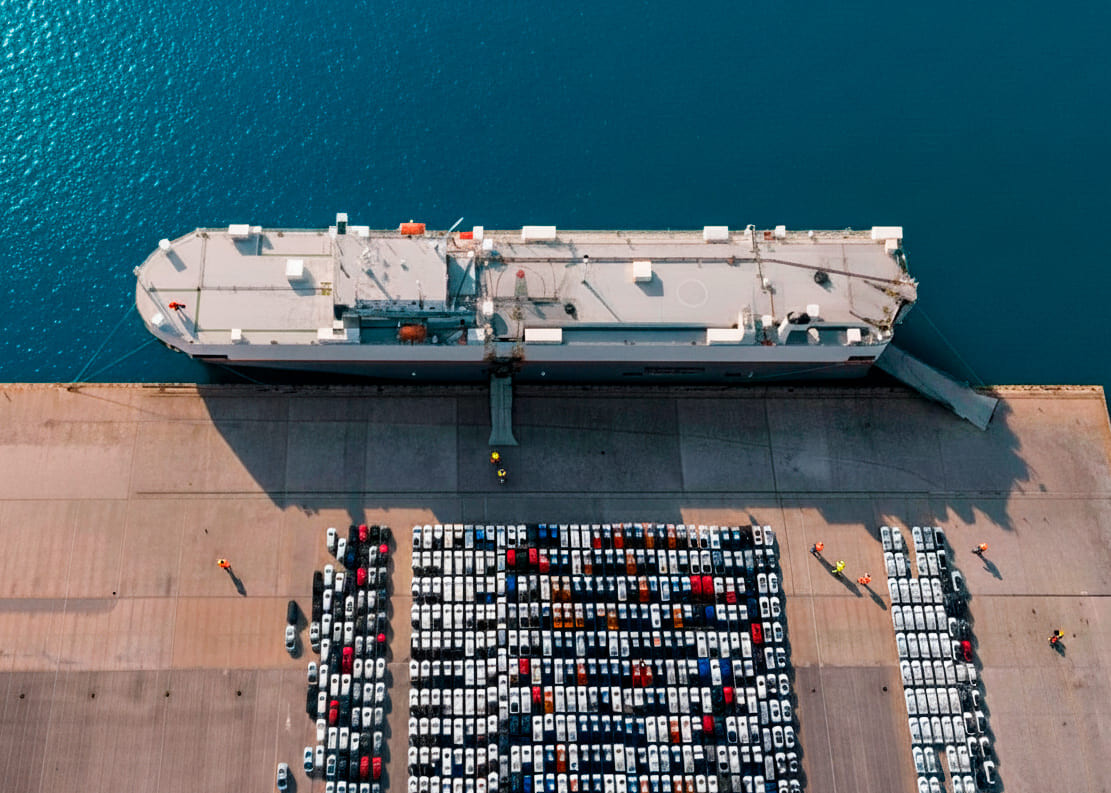
Ro-Ro (Roll-on/Roll-off) is ocean transport where equipment drives onto the vessel via a ramp and rolls off at the destination port. Unlike Lo-Lo/breakbulk (crane handling in a container or individually on slings), Ro-Ro eliminates crane lifting/lowering, which shortens the port phase and reduces the likelihood of damage during transshipment. In essence, the vessel is a multi-deck “parking garage” with internal ramps and built-in lashing points.
The Role of the Ramp
The external (stern/bow) ramp provides entry/exit of units, while internal ramps enable movement between decks. Key parameters: gradient around 10–15%, local breakover points (changes in grade), drive-lane width, and turning radii. For long-wheelbase or low-clearance equipment, agree in advance on the entry path, the use of ramp extensions, and check ground clearance at breakover points—this prevents deck contact.
CEU and Lane Meters
CEU (Car Equivalent Unit):
- What it is: a notional “car unit,” ≈ 1 passenger car.
- Where used: voyage planning for vessel loading, rating of serial passenger-car lots.
- When appropriate: homogeneous car lots with predictable geometry; the rate is often fixed “per unit.”
Lane meter (linear meter of deck lane):
- What it is: the length of marked deck lane occupied by the cargo, including working clearances for maneuvering/lashing.
- Where used: tall/long/heavy cargo, trailers, special equipment, mixed lots.
- When appropriate: a “flexible” tariff based on actual consumption of deck resources is needed.
How the tariff is calculated (simplified):
- For passenger cars: fixed rate per CEU × number of units.
-
For H&H (high & heavy): rate per lane meter × required meters + coefficients:
- Over-height (you occupy a “high” deck).
- Over-weight (increased lashing volume, limits of internal ramps).
- Additional operations: MAFI/SPMT, complex lashing, IMDG (if applicable).
Cargo Types: Self-Propelled, Towed, Non-Running (MAFI/SPMT)
Self-propelled
- Examples: passenger cars, trucks, buses, special-purpose machinery.
- Features: entry under own power/with a terminal tractor, standard lashing points, typical lashing.
Towed
- Examples: semi-trailers, trailers, roll trailers.
- Features: brought in by a terminal tractor, calculated by lane meters, verification of axle loads and turning radii.
Non-running / damaged
- Equipment: MAFI (roll trailer), SPMT (self-propelled modular transporters).
- Features: a separate “platform + cargo” plan, confirmation of loads on rollers/axle, additional lashing and escort.
Dangerous goods (IMDG):
- Requirements: UN number, class/packing group, segregations, coordinated deck placement.
- Result: permitted upon prior coordination with the line and terminal.
Limits by Dimensions/Weight and When to Switch to Container/Breakbulk
Constraints are set by deck heights (benchmark: “car” decks ~1.8–2.2 m; “high” decks ~4.6–5.2 m), ramp capacities, and internal turning radii. If sealed packaging/confidentiality is needed, if the size exceeds deck heights/ramp capabilities, or if finishes are critically sensitive to the atmosphere, a container is more rational. For ultra-heavy/oversized items beyond Ro-Ro limits, use breakbulk or semi-submersible vessels.
Economics and Rating
Pricing Models: CEU vs. Lane Meters
The cargo type determines the rating method. Serial passenger cars usually go at a “per unit” (CEU) rate. Tall, long, or heavy units are priced by lane meters with the required deck height considered, since such units consume more deck resources and reduce stowage flexibility.
Price Drivers: Over-Height/Over-Weight, IMDG, Non-Running/MAFI, Lashing Complexity
- Over-height increases cost due to the scarcity of “high” decks.
- Over-weight increases the volume of lashing and may restrict access to some decks due to internal ramp capacities.
- IMDG adds coordination of class and compatibility rules.
- Non-running delivery, MAFI/SPMT, and special gear increase operational labor intensity.
- Atypical lashing is required for a high center of gravity and non-standard lashing points, as well as when protecting contact areas is necessary.
Full Door-to-Door Estimate
The estimate includes ocean freight, port and terminal charges, preparation (washing, preservation, photo documentation as applicable), storage after Free-time expires, landside delivery and pickup (special equipment, passes, windows), and insurance. Transparency is achieved through an accurate unit description and synchronized gate-in/gate-out timing.
Budget Bottlenecks
Overspend is caused by early delivery (storage), an uncoordinated gate window and idle time, delays with documents and passes, as well as a confirmed route across decks for oversized units. Prevention — slot booking, confirmation of deck heights and internal ramps, a readiness checklist (battery, pressure, fuel for maneuvers), and issuing documents before arrival at the terminal.
Fleet and Infrastructure
PCC/PCTC: Deck Profiles and Placement of Buses/Trucks
PCC (Pure Car Carrier) are oriented toward passenger cars and therefore have more “low” decks (~1.8–2.2 m). PCTC (Pure Car and Truck Carrier) add “high” decks (~4.6–5.2 m) and reinforced areas for buses, trucks, and special chassis. When planning, account for the true height with top-mounted elements, maneuvering clearances, lashing points, and—for heavy chassis—axle loads and recommended parking locations (reinforced areas, near-centerline).
ConRo and Heavy-RoRo
ConRo combines a container deck and a Ro-Ro hold — it is rational for lots of “equipment + components in containers” and on trades with volatile assortments. Heavy-RoRo features reinforced decks and higher ramp capacities for tall/heavy units (rollers, transformers, drilling modules). Selection logic: the hybrid is for mixed flows and minimizing interfaces; the heavy deck is for confirmed mass/deck pressure and complex lashing.
Ramps and Intra-Ship Routes
The external ramp is usually the highest-capacity one (approximately 80–150 t). Internal ramps are weaker and often set the real access limit to “high” decks. Gradients of 10–15 % with breakovers require checking ground clearance and approach/departure angles, and limited turning radii in the holds are constrained by the unit’s length and wheelbase. For oversized units, the route is agreed in advance — from entry to the target deck.
Engineering Constraints
Deck Heights, Ground Clearance, Long Wheelbase, and the Risk of Bottoming Out
Three things decide everything — available deck height, actual ground clearance, and ramp geometry. Long-wheelbase chassis most often catch at breakover points, so the route is planned in advance, ramp extensions are added, and the deck is changed if necessary. For tall units, consider not only static height but also suspension squat during maneuvering, plus clearance above top elements like A/C units and antennas.
What to Check Before Booking
- wheelbase length, front and rear overhang
- minimum ground clearance in operating condition
- potential contact points on entry and exit
Loads — Center of Gravity, Axle Loads, and Deck Bearing Pressure
The placement plan is tied to the center of gravity coordinates. The higher the CG, the stiffer the lashing scheme required and the more cautious the deck selection on routes with noticeable roll. Axle loads are checked against axle and wheel limits, and specific deck bearing pressure is reduced with distribution plates, which also protect the surface.
Practical Minimum
- confirmed axle loads from the manufacturer or a weighbridge
- calculated area load per m² for the selected position
- confirmation that suitable lashing points of the required strength are nearby
Verification — Route Across Decks and Available Lashing Points
The engineering sheet is sent before booking. It includes L×W×H dimensions by topmost points, mass and axle loads, ground clearance, turning radius, and the location and strength of lashing points. The line responds by confirming the route from the external ramp to the target deck, portal heights, passage widths, turning areas, and the required lashing set. These parameters are transferred into pre-stowage and the lashing plan, which eliminates the risk of refusal on the delivery day and speeds up terminal handling.
Useful Add-Ons
- a deck-movement diagram with marks for potential contact points
- photos of actual lashing points on the unit and their allowable load
Equipment Preparation and Inspection
Washing, Preservation, and Surface Protection
The unit is submitted in inspection-ready condition. Wheel arches, seams, VIN areas, and potential damage points are cleaned. Bare metal is covered with a thin layer of wax inhibitor or anticorrosive; contact zones for lashing gear are lined with polyurethane or rubber. Add-ons are removed or rigidly secured to avoid play during maneuvering.
Mini-Check
- clean perimeter and glazing, readable VIN
- protection at strap/chain contact areas
- removed or rigidly secured external elements
Electrical and Fluids — Battery, Telematics, Fuel for Maneuvers, Fuels and Lubricants
The battery is charged, with quick access to disconnect. The alarm and telematics are set to service mode to prevent triggers and drain. Fuel is left in a volume sufficient for maneuvering at the terminal and on board, unless the line requires otherwise. Leaks are prevented by checking plugs and valves; for hydraulic systems, levers are fixed and operating pressure is kept under control.
What to Note in Handover Documents
- fuel and fluid levels
- battery condition and telematics mode
- availability of keys and access codes
Pre-Load Survey and Photo Capture — Shots, Reports, Handover of Keys and Papers
Inspection and photos are done in daylight. Required: four perimeter views, close-ups of vulnerable areas, cabin and instrument panel, VIN plates, mileage or engine hours, as well as tire pressure. The results are entered into the pre-load report, which is signed by the terminal or the driver. Keys, start instructions, and special maneuvering conditions are handed over against a receipt, and the entire photo archive is stored until the end of claim periods.
So You Don’t Lose the Small Stuff
- a separate envelope with keys and a handover checklist
- a link to the photo cloud folder in the header of the report
- a note about additional ramp extensions and where they are stored
Lashing and Safety
Principles, Angles, Lashing Points, Friction, and Contact Protection
We work “in shear,” not “in lift.” Keep sling and chain angles to the deck within 30–60°, and build the scheme symmetrically along the longitudinal and transverse axes. Use standard eyes on the frame and chassis; do not use suspension elements or piping. Increase friction with non-slip pads under wheels and supports. Protect contact zones with spacers to preserve coatings and edges.
Control During Voyage, Tension Checks, and Repositioning
In the first hours after departure, lashing settles, so we perform a re-tightening already in open water. After that, follow the deck officer’s inspection schedule and record changes in the lashing log. If the center of gravity changes due to operational tasks or heavier rolling is expected, reinforce the scheme and add lashing points.
What to Monitor
- tension marks on turnbuckles
- condition of pads and chocks
- possible micro-movements due to suspension travel
Special Cases — High Center of Gravity, Narrow Track, MAFI/SPMT
For a high CG, add diagonal stays and wheel chocks and, where possible, lower the installation height by choosing a lower deck or removing top elements. Compensate for a narrow track with additional wedges and by increasing the number of lashing branches. For carriage on MAFI or SPMT, prepare a combined “platform plus cargo” plan, lash the platform to the deck separately, and confirm allowable loads on rollers and axles.
Operations and Documents
Slot Booking and Deck Planning
The request includes dimensions by topmost points, gross mass and axle loads, ground clearance, turning radius, lashing points, and running status. The line responds by confirming the target deck, the route through internal ramps, admissible gradients and turning radii, the parking position, and lashing requirements. Gate-in window, Free-time, and the list of documents for terminal access are fixed separately.
What to Attach to the Request
- current photos of the unit and lashing points
- an entry maneuver diagram
- desired delivery and pickup dates
Terminal Procedures — Gate-In, Inspections, Security, Gate-Out
At gate-in we perform identification, an initial inspection, and photography, then receive a parking area and marking. Access is organized by passes and ISPS rules; movement follows terminal routes and stevedores’ instructions. On discharge, repeat inspection and photography, draw up a remarks report, and gate out. Keys and documents are released against a power of attorney and a control checklist.
Documents and Regulation, IMDG Coordination
The minimum set includes a commercial invoice, a packing list if available, an export declaration or number, and a Bill of Lading with an accurate unit description. The description specifies make and model, VIN or serial number, mass, dimensions, and running status. Comply with SOLAS safety requirements, ISM and ISPS for management and security, and the CSS Code for lashing and stowage. For dangerous goods, IMDG rules apply, and the UN number, class, packing group, special provisions, compatibility, and deck location are confirmed in advance.
Checks Before Issuing the Bill of Lading
- matching VIN and actual dimensions
- correct goods description and value
- noted IMDG parameters and the agreed stowage scheme
Timelines and Routes
What Shapes Transit
The final transit time is affected by more than the sea leg. The calculation includes the berth window, quay queue, ramp and crew availability, and the actual call frequency on the trade. The weather factor for Ro-Ro is lower than for crane-based schemes, but strong crosswinds and storms can still shift the schedule. The most vulnerable point is synchronizing landside legs with the gate-in window and timely pickup after discharge. Slot violations quickly turn into storage and extra internal port moves.
How to Manage Transit
- synchronize delivery with the confirmed gate-in window;
- check the call schedule 48–72 hours before movement;
- have a pickup contingency in case berthing is rescheduled.
Typical Trades
- Baltic — North Africa — pronounced seasonality, sensitivity to narrow straits, peaks in car flows.
- Europe — Middle East — stable network and high volume of mixed “cars plus special equipment” lots.
- Asia — Africa — less regular frequencies; ConRo or Heavy-RoRo is often required for project assortments.
- Cabotage and short sea — high call frequency and a short port phase with strict slot discipline.
Comparing Alternatives and Risk Management
Ro-Ro vs. Container and Breakbulk
Ro-Ro is chosen for self-propelled and towed equipment when a short port phase and no cranes are important. Container wins where sealed packaging, confidentiality, and consolidation of small components are required, as well as for atmospheric protection. Breakbulk and semi-submersible vessels remain tools for extreme dimensions and masses or when non-typical stowage using reinforced decks and deck machinery is required.
Key Risks and How to Reduce Them
Damage most often occurs during maneuvers and at turning points. Risk drops if the entry trajectory is agreed in advance, additional ramp extensions are used, and height and width are marked. Corrosion is contained by washing before delivery, spot preservation, and protecting contact zones, as well as minimizing time on open decks and in the terminal. Loss of components is prevented by access control, sealing the cabin, and strict key control. Weather fluctuations are factored into the lashing plan and compensated by timely re-tightening.
Insurance and Claims Handling
The cargo policy must explicitly state exclusions and coverage terms, including inherent vice and rust/oxidation. For sensitive items, it makes sense to seek a minimal or zero deductible. An independent surveyor documents the condition before and after the voyage, the actual lashing scheme, and the circumstances of the incident — this record speeds agreement and reduces disputability.
Practice
Mini-Cases
Buses on PCTC (lot of 10–20 units)
- Before booking: confirm height by topmost points (A/C units, antennas), fold mirrors, check turning radii/turning pads, request a deck with ~4.8–5.2 m clearance.
- At loading: height marking, escort by the terminal team, protection of contact zones under straps/chains.
- Result: short port phase, single rate for the lot, minimal maneuvering risks.
Non-running road equipment on MAFI (high CG)
- Engineering: select a roll trailer by capacity, calculate the “platform + cargo” scheme, confirm loads on rollers/axle and the platform’s lashing points to the deck.
- Operations: delivery by tractor, wheel chocks/stoppers, diagonal stays, re-tightening after putting to sea.
- Economics/risk: extra costs (MAFI rental, lashing) are offset by avoiding crane operations and reducing the probability of damage.
Tools: Preparation Checklist and Rate Brief
Preparation checklist (brief):
- Clean for inspection (perimeter, VIN areas, vulnerable spots).
- Protection of strap/chain contact zones; wheel chocks.
- Add-ons secured/removed; cabin free of loose items.
- Battery charged; quick disconnect access; telematics in service mode.
- Fuel for maneuvers (as required by the line/terminal).
- Set of keys/instructions; pre-load survey and photos (perimeter, cabin/instrument panel, VIN, vulnerable areas).
- Inspection report signed; copies in the delivery file.
Rate brief (minimum data):
- Dimensions and mass: L×W×H (by topmost points), gross mass, axle loads.
- Geometry/handling: ground clearance, wheelbase/turning radius, running/non-running status, lashing points.
- Constraints/requirements: desired deck/ramp, over-height/over-weight, IMDG (if applicable).
- Timing: target gate-in/gate-out windows and desired delivery date.
Glossary
- CEU (Car Equivalent Unit) — a notional “car unit” for capacity/rates on serial passenger cars.
- Lane meter / lane meters — linear meter of deck lane / total lane length occupied by the cargo.
- PCC / PCTC — vehicle carriers: PCC for passenger cars; PCTC with “high” decks for buses/trucks.
- ConRo — hybrid vessel: container deck + Ro-Ro hold for rolling cargo.
- Heavy-RoRo — Ro-Ro with reinforced decks and higher ramp capacities for heavy/tall units.
- Heavy-deck — a reinforced deck with increased allowable area/axle loads.
- MAFI / SPMT — roll trailer/self-propelled modular transporter for non-running or large equipment.
- Ramp (external/internal) — entry/exit (external) and movement between decks (internal); gradient and capacity are critical.
- Ramp extensions — additional bridging ramps to smooth breakover at entry/exit.
- Ground clearance — determines risk of deck contact at breakover and entry/exit thresholds.
- Center of gravity (CG) — affects the lashing scheme: the higher it is, the “stiffer” the lashing and deck requirements.
- Axle loads / deck bearing pressure — load per axle/wheel and specific deck pressure; checked against deck/ramp limits.
- Gate-in / Gate-out — terminal entry/exit; usually tied to a slot and Free-time.
- Free-time / Storage — free terminal storage period / paid storage after it expires.
- Pre-load survey — pre-voyage inspection and photo capture of the unit’s condition before loading.
- Stowage plan / Pre-stowage — (pre)placement scheme by decks; agreed before loading.
- Lashing / Lashing plan / Lashing log — cargo securing / agreed securing plan / inspection and re-tightening log.
- B/L (Bill of Lading) — the primary transport document with an accurate unit description.
- Invoice / export declaration — commercial invoice and export document required for clearance and release.
- SOLAS / ISM / ISPS / CSS Code — core standards: safety at sea; safety management system; ship/port security; lashing/stowage code.
- IMDG (segregations, UN number) — maritime dangerous goods rules: UN identification, class/packing group, segregation requirements.
- Wheel chocks — anti-roll blocks to secure position on deck.