
 English
 Русский
 Español
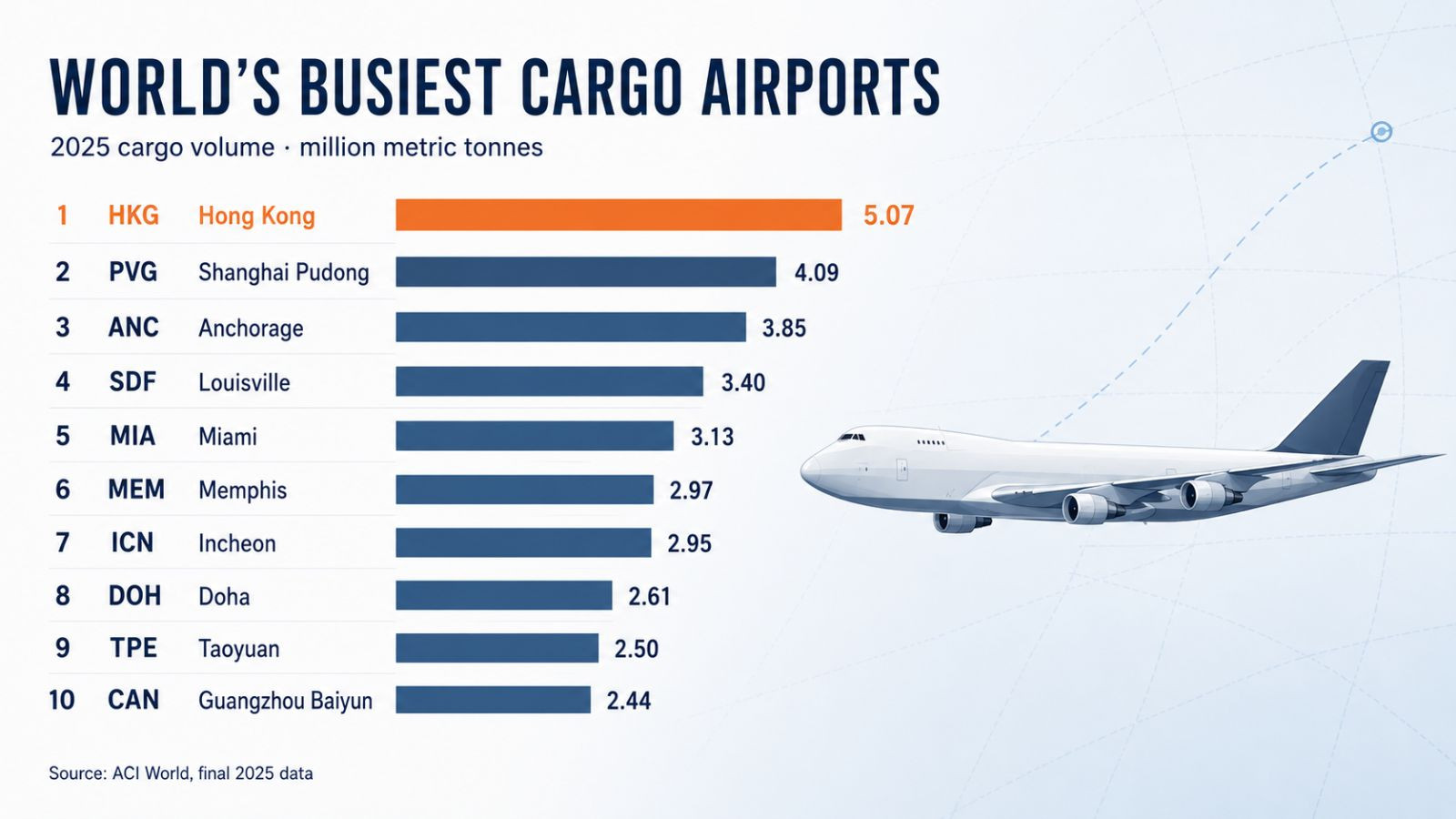
The world's busiest cargo airports are ranked by the actual annual volume of cargo handled, not by passenger traffic, airport area, number of flights, or the terminals' stated handling capacity. This ranking uses Airports Council International World final data for calendar year 2025. The metric includes loaded and unloaded freight and mail and is expressed in metric tons.
At a glance
Hong Kong International Airport (HKG) ranks first, having handled 5,066,345 metric tons of freight and mail in 2025. The ranking is based on final ACI World statistics and reflects each airport's actual cargo volume for the calendar year.
The world's 10 busiest cargo airports
| Rank | Airport | Country or territory | IATA | 2025 cargo volume | Change from 2024 |
|---|---|---|---|---|---|
| 1 | Hong Kong International Airport | Hong Kong SAR, China | HKG | 5,066,345 t | +2.7% |
| 2 | Shanghai Pudong International Airport | China | PVG | 4,091,941 t | +8.3% |
| 3 | Ted Stevens Anchorage International Airport | United States | ANC | 3,854,614 t | +4.2% |
| 4 | Louisville Muhammad Ali International Airport | United States | SDF | 3,396,437 t | +13.5% |
| 5 | Miami International Airport | United States | MIA | 3,128,165 t | +13.6% |
| 6 | Frederick W. Smith International Airport, Memphis | United States | MEM | 2,969,502 t | -20.9% |
| 7 | Incheon International Airport | Republic of Korea | ICN | 2,954,684 t | +0.3% |
| 8 | Hamad International Airport | Qatar | DOH | 2,614,214 t | -0.1% |
| 9 | Taiwan Taoyuan International Airport | Taiwan | TPE | 2,499,899 t | +10.1% |
| 10 | Guangzhou Baiyun International Airport | China | CAN | 2,439,248 t | +2.4% |
Source for all values and positions in the table: ACI World's final global airport ranking for 2025. For ANC, ACI statistics include transit cargo.
1. Hong Kong International Airport (HKG)

Hong Kong retained first place and increased its cargo volume by 2.7%. The airport connects manufacturing centers in mainland China, particularly the Greater Bay Area, with the global airfreight network. HKG handles standard and time-critical shipments, e-commerce goods, high-value products, and temperature-controlled cargo. According to the airport operator, air cargo accounted for more than 45% of Hong Kong's external trade by value in 2025. Key participants in the cargo infrastructure include Cathay Pacific Cargo, DHL, Hong Kong Air Cargo Terminals, and Asia Airfreight Terminal.
HKG is worth considering for shipments from Southern China to Europe, North America, and other parts of Asia, especially when frequent flights, fast connections, or specialized cargo handling are important. For shipments originating in mainland China, compare trucking to Hong Kong with a direct departure from Shenzhen or Guangzhou. Factor in border formalities, the cost of the road leg, and the time required to hand the cargo over to the terminal.
2. Shanghai Pudong International Airport (PVG)

Pudong ranks second for the second consecutive year. Its cargo volume grew by 8.3% in 2025 and exceeded 4 million metric tons for the first time. It is Shanghai's main air cargo hub and one of the principal gateways for Chinese manufacturing to international markets. An extensive cargo network supports e-commerce shipments, electronic components, biopharmaceutical products, and other high-value or time-critical cargo. PVG's growth reflects the expansion of international flows through Chinese airports.
PVG is well suited to exporters and importers operating in Shanghai, Jiangsu, Zhejiang, and other parts of the Yangtze River Delta. It is particularly relevant for regular shipments of electronics, industrial equipment, pharmaceuticals, and e-commerce orders. When selecting a route, check the trucking time from the warehouse to the cargo terminal, the availability of a direct flight, and export customs clearance requirements.
3. Ted Stevens Anchorage International Airport (ANC)

Anchorage moved from fourth to third place after handling 3,854,614 metric tons, 4.2% more than the previous year. Its importance comes not from the size of the local market but from its position along the shortest routes between Asia and North America. Cargo aircraft use ANC for refueling, crew changes, transshipment, and shipment redistribution. Alaska law also gives carriers greater flexibility to transfer cargo between airlines. ACI's figure for ANC includes transit cargo, an important distinction when comparing it with airports where regional imports and exports generate most of the volume.
For most shippers, ANC is not the origin or destination airport but an intermediate point in the carrier's schedule. Routing through Anchorage can be effective for time-critical shipments between East Asia and North America, but it should be assessed by total transit time, the number of transfers, and liability terms at the connection, not by the airport's high position in the ranking.
4. Louisville Muhammad Ali International Airport (SDF)

SDF rose to fourth place after cargo volume increased by 13.5%. The airport is home to UPS Worldport, the central hub of UPS's global air network. As a result, much of its traffic consists of time-critical parcels and consolidated shipments that are sorted overnight and dispatched to destinations in the United States and abroad. Louisville's central location and the airport's links to the ground delivery network make SDF one of the most important express freight hubs.
Louisville is particularly important for companies using UPS services and time-definite delivery within the United States or between continents. The hub is suitable for parcels, spare parts, samples, medical supplies, and other urgent shipments. For a standard palletized shipment, SDF is practical only when a suitable UPS rate and route are available, as the airport is primarily integrated into the network of a single major carrier.
5. Miami International Airport (MIA)

Miami recorded the highest growth rate in the top ten at 13.6%, moving from seventh to fifth place. MIA is the main air cargo gateway between the United States, Latin America, and the Caribbean. It handles flowers, fruit, vegetables, and other perishables, as well as pharmaceuticals, electronics, and e-commerce shipments. The airport reports that more than 35 cargo airlines operate there, giving shippers a wide choice of direct and connecting routes.
MIA is a logical option for routes between North and South America, especially for products with a short shelf life. When shipping flowers, food, or medicines, check not only flight time but also cold-storage availability, the schedule for sanitary or veterinary inspections, customs clearance time, and the ability to collect cargo from the airport immediately.
6. Frederick W. Smith International Airport, Memphis (MEM)

Memphis fell from third to sixth place. Cargo volume declined by 20.9% to 2,969,502 metric tons, the sharpest drop among ACI's 20 busiest cargo airports. ACI attributes the decline to the loss of the U.S. Postal Service contract in late 2024. Nevertheless, MEM remains home to the FedEx World Hub and one of the central nodes in the global express delivery network. In August 2026, the airport was officially renamed for FedEx founder Frederick W. Smith; its IATA code, MEM, did not change.
MEM is most relevant to shippers using FedEx Express. Memphis is a convenient hub for time-critical documents, parcels, components, and small shipments with a firm delivery deadline. The decline in total cargo volume does not mean this specialization has disappeared, but for large palletized shipments, it is worth comparing the express rate separately with standard airfreight through another U.S. airport.
7. Incheon International Airport (ICN)

Incheon handled 2,954,684 metric tons, 0.3% more than in 2024, but fell from sixth to seventh place as other hubs grew faster. The airport serves as a transshipment hub for Northeast Asia, connecting the Republic of Korea with China, Japan, Southeast Asia, Europe, and North America. A free economic zone, FedEx and DHL cargo terminals, a perishables handling center, and international distribution center warehouses support shipments of electronics, semiconductor manufacturing equipment, pharmaceuticals, and e-commerce goods.
ICN is suitable for distributing cargo between the Republic of Korea, Japan, China, and Southeast Asian countries, as well as for onward transport to Europe and North America. It is particularly useful for high-value components and temperature-sensitive products. For transit shipments, check the minimum connection time, whether storage is available without removing the cargo from the controlled area, and whether the required temperature can be maintained between flights.
8. Hamad International Airport (DOH)

Doha Airport retained eighth place. Cargo volume was virtually unchanged at 2,614,214 metric tons, 0.1% below the 2024 level. DOH is the home hub of Qatar Airways Cargo and redistributes traffic between Asia, Europe, Africa, and the Americas. Specialized infrastructure and temperature-controlled vehicles used to move cargo between aircraft and warehouse are particularly important for pharmaceuticals, fresh produce, and other sensitive goods.
DOH is suitable for routes where no appropriate direct cargo flight is available between Asia, Africa, the Middle East, and Europe. A connection through Doha can shorten transit time compared with a road-air option, particularly for pharmaceuticals and fresh products. Before booking, confirm the transit duration, temperature-control arrangements during transfer, and Qatar Airways Cargo restrictions for the specific cargo category.
9. Taiwan Taoyuan International Airport (TPE)

Taoyuan moved from tenth to ninth place after growing by 10.1%. The airport handled almost 2.5 million metric tons of cargo in 2025. Its location in East Asia and connection to Taiwan's manufacturing base support flows of semiconductors, electronics, industrial equipment, and other goods with a high value-to-weight ratio. The cargo divisions of China Airlines and EVA Air play a significant role in TPE's network.
TPE is particularly important for shipments of electronics, semiconductor components, equipment, and urgent parts from Taiwan. The high value of these goods justifies air transport and enhanced security measures. For battery-powered devices, verify the dangerous goods classification, permitted state of charge, packaging, and required transport documentation in advance.
10. Guangzhou Baiyun International Airport (CAN)

Guangzhou Baiyun handled 2,439,248 metric tons of freight and mail, 2.4% more than the previous year. Despite the increase, the airport fell from ninth to tenth place because Taoyuan grew faster. CAN serves one of China's largest manufacturing and export regions, the Guangdong-Hong Kong-Macao Greater Bay Area. International cargo routes, China Southern Air Logistics capacity, and infrastructure for cross-border e-commerce strengthen its role in Southern China's supply chains.
CAN is suitable for companies sourcing goods in Guangzhou, Foshan, Dongguan, and other industrial centers in Guangdong Province. It is a practical gateway for consolidated shipments, e-commerce goods, electronics, clothing, and industrial products. When choosing among Guangzhou, Shenzhen, and Hong Kong, compare direct-flight availability, distance from the warehouse, export clearance rules, and the total cost of delivery to the destination airport.
What changed in the ranking
The composition of the top ten did not change from 2024, but there were several notable shifts within it. Anchorage moved from fourth to third place, Louisville from fifth to fourth, and Miami from seventh to fifth. Memphis fell from third to sixth after cargo volume declined by 20.9%. Taoyuan overtook Guangzhou to take ninth place.
The changes are even more pronounced when the new ranking is compared with the earlier version of this article, which was based on 2022 data. Los Angeles and Narita dropped out of the top ten, replaced by Doha and Guangzhou. Shanghai rose from fourth to second, Miami from eighth to fifth, while Memphis fell from second to sixth.
Why cargo airports matter to international trade
Airfreight costs more than sea or rail transport but offers a significant time advantage. The largest international air cargo hubs therefore concentrate shipments for which speed, security, or predictability matters more than the lowest possible rate. These include electronics and components, pharmaceuticals, urgent spare parts, high-value goods, documents, perishables, and e-commerce orders.
An airport's role is not determined by volume alone. Shippers also need to consider flight frequency, the ability to transfer cargo between airlines, customs clearance times, cold-storage availability, dangerous goods handling, and links to road and warehousing networks. Hong Kong and Shanghai serve as gateways to major manufacturing regions, Anchorage as a transit point on intercontinental routes, Louisville and Memphis as express delivery hubs, and Miami as a link between North America and Latin America.
The highest position in the global ranking does not mean an airport is the best choice for every shipment. Route selection should account for shipment geography, available airlines, cargo type, temperature and security requirements, connection time, and the cost of the ground leg.
How airport cargo volume is measured
ACI World defines cargo volume as the weight of loaded and unloaded freight and mail. The data is expressed in metric tons and covers shipments actually handled during the calendar year. It is not the terminals' design capacity or the combined weight of cargo that all aircraft served could theoretically carry.
The ranking is based on data that airports submit to ACI using a standardized form. Preliminary results are published in April and confirmed in July after verification. This article uses the final release dated July 15, 2026, compiled from data reported by 2,817 airports in more than 180 countries and territories.
Local statistics may differ from the ACI table because of units of measurement, rounding, and metric scope. U.S. airports, for example, often report volume in pounds or U.S. tons. To maintain comparability, every position and value in this article comes from the same international system and is stated in metric tons.
Frequently asked questions
What is the world's busiest cargo airport?
According to ACI World's final 2025 data, Hong Kong International Airport (HKG) ranks first. It handled 5,066,345 metric tons of freight and mail.
How is an airport's cargo volume measured?
ACI's ranking counts the weight of freight and mail loaded and unloaded during the calendar year. The figure is expressed in metric tons. For Anchorage, the statistics also include transit cargo.
Which airports are in the top ten?
In 2025, the top ten comprised Hong Kong, Shanghai Pudong, Anchorage, Louisville, Miami, Memphis, Incheon, Doha, Taoyuan, and Guangzhou Baiyun.
How does a cargo airport differ from a passenger airport?
The same airport can serve both passengers and cargo, but a major cargo hub particularly depends on freight terminals, cargo aircraft stands, warehouses, sorting capacity, cold-storage areas, customs infrastructure, and links to ground delivery networks.
Why are the busiest passenger airports not always included in the cargo ranking?
Passenger traffic and cargo volume measure different activities. An airport with a large number of passengers may not have an extensive cargo flight network or specialized freight infrastructure. Conversely, Anchorage, Louisville, and Memphis rank highly because of transit and express cargo operations rather than passenger traffic.
Sources and data
- ACI World, final global airport ranking for 2025 and ACI World methodology.
- Airport Authority Hong Kong, HKIA cargo volume for 2025.
- Civil Aviation Administration of China, 2025 airport statistics; the document confirms freight and mail figures for mainland Chinese airports.
- Alaska International Airport System, Anchorage's role in air cargo.
- Louisville Regional Airport Authority, SDF's 2025 operating results.
- Miami International Airport, 2025 cargo results.
- Memphis-Shelby County Airport Authority, MEM statistics for 2025.
- Incheon International Airport Corporation, official airport statistics.
- Hamad International Airport, 2025 operating results.
- Taiwan Taoyuan International Airport, 2025 cargo volume and Guangzhou's official portal, development of the Baiyun cargo hub.